Screenshot from 2026-04-20 13-21-13

ARTIFICIAL INTELLIGENCE AND COPYRIGHT LEGAL ALERT JANUARY 2026

THE REIGNING PRINCIPLE OF
HUMAN AUTHORSHIP AND
CREATIVITY

The rapid advancement of artificial intelligence (AI), particularly generative AI capable of producing text, images, music and other creative outputs, has disrupted traditional understandings of copyright law. Copyright regimes were historically developed on the premise of human creativity and authorship. The emergence of AI systems capable of autonomous or semi- autonomous creative expression raises complex legal questions
regarding ownership, infringement, liability, and enforcement. This article examines the intersection of AI and copyright law in Kenya, drawing comparative lessons from recent judicial developments in the United States and the United Kingdom.

HUMAN AUTHORSHIP AND COPYRIGHT PROTECTION

A foundational principle of copyright law is that protection subsists only in works resulting from human intellectual effort. In Kenya, the Copyright Act of 2001 implicitly presumes human authorship in recognizing protection for original works that are the product of skill, labour and judgment. Although the Act does not expressly address prevailing interpretation is that originality must be attributable to a human author.

In the matter of Aryeh Movement Limited vs. Cynthia Belinda Akoth Obello (COPTA/E001/2025), the Copyright Tribunal upheld the principle of human authorship in copyright protection against AI-generated works. In the instant case, the Appellant argued that the literary works were jointly authored, with the Claimant contributing as a scriptwriter and AI-image illustrator. This raised the broader legal question of whether, under Kenyan law, AI-generated works can attract copyright protection. The Tribunal noted that neither party produced the disputed literary works, nor did KECOBO furnish the lodged materials. Nonetheless, the Respondent did not dispute the assertion that portions of the works were AI-generated.

The Tribunal noted that the Copyright Act does not expressly address AI-generated works. Instead, Section 22(3) provides that:

“A literary, musical or artistic work shall not be eligible for copyright unless sufficient effort has been expended on making the work to give it an original character; and the work has been written down, recorded or otherwise reduced to material form.” This test presupposes human involvement, therefore works generated autonomously by AI cannot meet the statutory threshold unless can author demonstrates sufficient human intervention to give the work originality.


UNITED STATES OF AMERICA

In Thaler v. Perlmutter, Dr. Thaler developed a generative AI system named “Creativity Machine” and used it to create an image titled “A Recent Entrance to Paradise.” The U.S. Copyright Office denied Dr. Thaler’s application to register copyright for the image, in which he listed Creativity Machine as the “author.” Following the Copyright Office’s denial, Dr. Thaler appealed the decision to the U.S. District Court for the District of Columbia, which upheld the denial. Dr. Thaler then appealed to the D.C. Circuit, which unanimously affirmed the district court’s decision and the Copyright Office’s denial of the application. The Appellate panel emphasized that authors are at the center of the Copyright Act. Although the Copyright Act does not define the term “author”, the Court provided several provisions of the said Act that supported the interpretation of “Author” as a human being.


  1. Ownership and inheritance provisions which are premised on the author’s ability to own property, something that a machine or software is incapable of doing so;
  2. Provisions limiting the duration of copyright based on the lifespan of the author, which concept cannot be applied to machines;
  3. Provisions as to the legal capacity to provide an authenticating signature or demonstrate intent, especially in determining joint authorship, which concept of legal capacity machines lack.

UNITED KINGDOM

The case of THJ Systems Ltd vs Sheridan [2023] EWCA Civ 1354 related to a dispute over who held copyright to a program called OptionNET Explorer, which takes live (or historic) market data and presents it in the form of a table of “call” and “put” positions displayed side by side with a graph showing the “risk profile”. The Court of Appeal made reference to the Infopaq International A/S v Danske Dagblades Forening [2009] ECR I-6569 where the Court of Justice held that “copyright within the meaning of Article 2(a) of Directive 2001/29 is liable to apply only in relation to a subject-matter which is original in the sense that it is its author’s own intellectual creation”. It concluded that the software developer had made sufficient free and creative choices such that the selection of colours and font styles in the visual charts to be deemed the human author under conventional copyright principles.


Comparative Analysis : AI and Copyright Across Jurisdictions

Jurisdiction Key Principle
Kenya (Copyright Act 2001) Works must show “sufficient effort” to give character (Section 22(3))
USA (Thaler v. Perlmutter) Copyright requires human authorship; AI cannot be listed as author
UK (THJ System Ltd v Sheridan) Author must make ‘free and creative choices’ (Infopaq test)

Here’s the extracted text:


The Role of ESK Advocates

As businesses, creators, and technology developers navigate the evolving interface between artificial intelligence and copyright law, ESK Advocates LLP is well positioned to provide strategic, practical, and forward-looking legal support. The firm advises clients on general copyright ownership as well as authorship risks arising from AI-generated works.

KEY TAKEAWAYS

  1. Human Authorship is Essential
    AI-generated works without human intervention lack copyright protection
  2. The “Sufficient Effort” Test
    Works must demonstrate skill, labor and judgement to qualify
  3. Global Consensus
    Emerging Kenya, USA and UK all require human creative input
  4. Practical Implications
    Businesses must document human contributions to AI-assisted work

CONCLUSION

Artificial intelligence poses a fundamental challenge to traditional copyright doctrine by separating creative output from human authorship. Comparative jurisprudence from the United States and the United Kingdom demonstrates judicial reluctance to extend copyright protection to purely machine-generated works. As for Kenya, our legal landscape continues to uphold the principle of human authorship in copyright protection. Through careful judicial interpretation and targeted legislative reform, Kenya can foster innovation while safeguarding the rights of creators in an increasingly AI-driven economy.


Article by
Teresia Wamaitha
Managing Partner


If you want, I can now merge everything into a polished, ready-to-paste WordPress article (with headings + formatting).


Screenshot from 2026-04-20 12-44-54

NAVIGATING THE STARTUP ECOSYSTEM IN KENYA

In the wake of the fourth industrial revolution, Kenya has been lauded as the go-to place for investments in sectors like healthcare, education, agriculture, manufacturing, etc. All this has been enabled due to seemingly youthful population that is skilled enough to bring to the fore these aspirations. Kenya’s youth have put themselves on the map for contributing through training through Language Models (LMs) like ChatGPT to launching products. Founders have decided to take a risk not only nurture these talents and but also contribute to the country’s GDP.

However, even with the surge in technological hubs and fintechs over the years, Kenya still finds itself not able to support the full transition and integration of these technological hubs and fintechs into the Kenyan market. The most recent fintech to close shop was Bonto, which announced their exit from the Kenyan market less than 8 months after getting their license. They stated that they could not break even due to the fact that there was a lot of CBK compliance requirements which crippled them into not making bank.

Dissecting the Startup Bill, 2022

In an effort to support and promote the country’s start-up ecosystem (which is seemingly an industrialization gold mine that is yet fully tapped), the Kenyan legislators drafted the Startup Bill 2022 whose object is to provide a framework to encourage growth and sustainable technological development, new entrepreneurship environment, create a favourable environment for innovation by attract Kenyan talents and capital.

Therefore, what is a Kenyan Start-up under this Bill? For a business to be recognized as a Kenyan startup, it must:

• Have its headquarters in Kenya,
• Be at least 51% Kenyan-owned,
• Dedicates at least 15% of expenses to research and development,
• Reinvest the profits in the early years instead of distributing them

Further, the Bill provides for the establishment of the Startup Fund whose purpose is to offer loans and grants for qualifying startups, equity financing through partnerships with investors, and training and incubation support via approved innovation hubs.

Alvin Toffler once said, “The great growing engine of change – technology.” Indeed, Kenyan market should enable the growth and sustainable technological development through such vehicle called Start-Ups and not stifle them as evolution of markets through technology is inevitable.

What are the compliance requirements for Start-Ups, Fintech in Kenya?

The legal framework governing Start-ups and fintechs includes:

• Central Bank of Kenya Act
• Banking Act
• Microfinance Act
• National Payment Systems Act
• Kenya Deposit Insurance Act
• Anti-Money Laundering and Counter-Terrorism Financing Act
• Data Protection Act
• Capital Markets Act

The Central Bank of Kenya (CBK) oversees fintechs that are involved in deposit taking, money services, money remittance, digital lending, wallet services or operate a payment system in Kenya.

Key CBK requirements for fintech startups

• The National Payment Systems Act provides that fintechs need to apply for Payment Service Provider licenses as comply with specific authorizations.

• As per the Digital Credit Providers regulations, Digital Credit Providers must apply for CBK authorization as well as supply information on business model, capital and suitability of owners and management.

• Startups must provide information in regard to minimum capital fit and proper requirements for management and board, internal controls and risk management frameworks.

• On operational and technical standards, fintechs need to satisfy the CBK on their cybersecurity readiness, resilience and capacity to handle projected transaction volumes for payment systems and PSPs.

• Under AML/CFT requirements, there is an obligation to perform customer due diligence, file suspicious transaction reports and cooperate with the Financial Reporting Centre. Stronger thresholds for KYC are expected.

• There should be clear disclosure on fees, loan terms, interest computation and dispute resolution as part of consumer protection and transparency requirements. Consumers should at all times be protected from predatory lending. To assess customer creditworthiness, fintechs need to integrate with CBK’s Credit Reference Bureau (CRB) system.

• As per the Data Protection Act, fintechs are required to comply with the Act in regards to handling customer financial and personal data.


Where we come in:

At ESK Advocates LLP, we offer start-up and fintech founders actualize their dreams by facilitating and enabling them:

✔ Register their businesses with the Business Registration Service;

✔ Applying for relevant licenses from CBK or capital markets authority;

✔ Setting up internal controls for Anti-Money Laundering and Countering the Financing of Terrorism (AML/CFT) compliance; and

✔ Ensuring data privacy and secure customer information as well as maintaining transparent communication with users.


Article by
Sheila Nekesa,
Associate Advocate

Screenshot from 2026-04-20 12-40-29

INTERNATIONAL DEVEOPMENT ON ENVIRONMENTAL LAW

CLIMATE CHANGE & THE LAW
A Legal Revolution the World and Kenya Cannot Ignore

INTRODUCTION
“Climate change is no longer merely a scientific or political challenge; it is an urgent and expanding legal one.”
Between 2022 and 2025, the world’s most authoritative legal institutions delivered a series of landmark rulings that fundamentally redefine what international law demands of states, corporations, and individuals in the face of the climate crisis.

Taken together, these decisions constitute a legal revolution, one whose implications land with immediate force in Kenya. This article examines six interconnected developments: a breakthrough human rights ruling from Europe, the most consequential advisory opinion in the history of the International Court of Justice, the emergence of legal frameworks protecting small island nations, the long-awaited creation of a Loss and Damage Fund, rising corporate climate liability, and the growing global movement to criminalize the worst forms of environmental destruction. Each development has direct relevance to Kenyan law, Kenyan businesses, and Kenyan communities.

I. The Women Who Changed Climate Law
KlimaSeniorinnen v. Switzerland —
European Court of Human Rights, 9 April 2024


The story of modern climate human rights litigation begins not with a powerful state or a well-funded legal team, but with more than 2,000 Swiss women in their seventies.

Calling themselves Verein KlimaSeniorin-nen Schweiz, Senior Women for Climate Protection Switzerland had watched their country’s summers grow increasingly brutal. They were not abstract complainants. They documented cardiovascular episodes during heatwaves, described their inability to leave their homes during extreme heat events, and explained in medical detail why elderly women are physiologically the most vulnerable group to rising temperatures.

Swiss domestic courts turned them away, ruling that climate change was a matter for politicians, not Judges. So, the women took their case to Strasbourg. On 9 April 2024, the Grand Chamber of the European Court of Human Rights which the most powerful human rights court in the world, ruled in their favour.

The judgment was historic: for the first time, an international court had found that a state’s failure to act adequately on climate change violated the fundamental human rights of its citizens. The Court’s core finding:

The right to private and family life, protected under Article 8 of the European Convention, encompasses a right to effective protection from the serious adverse effects of climate change.

Switzerland had no binding national carbon budget and no enforceable greenhouse gas reduction targets, and
that insufficiency was a human rights violation. Switzerland was ordered to pay €80,000 in costs and placed under the supervision of the Council of Ministers to ensure its climate framework meets Convention standards. The message to governments world-wide was unambiguous: aspirational climate goals are no longer sufficient.What the law requires is an enforceable framework. ”

What This Means for Kenya

While KlimaSeniorinnen arose within the European human rights framework, its legal reasoning is directly applicable in Kenya. Article 42 of the Constitution of Kenya 2010 guarantees every person the right to a clean and healthy environment. Article 70 goes further to state that any person may seek environmental redress without needing to prove personal injury.

Kenya’s standing provisions are, in fact, more generous than what the ECHR had to construct from scratch in KlimaSeniorinnen. In practical terms, this means Kenyan civil society organizations and communities affected by climate harm such as pastoralists in Turkana, farmers in the Rift Valley and fishing communities on the coast can bring constitutional climate petitions today, without waiting for new legislation. The Swiss women showed the world it can be done. The Kenyan Constitution already opens the door.

II. The World’s Highest Court Speaks

ICJ Advisory Opinion on the Obligations of States in Respect of Climate Change 23 July 2025

If KlimaSeniorinnen lit the match, the ICJ advisory opinion of 23 July, 2025 was the moment the world felt the heat. It began in 2019, when 27 law students at the University of the South Pacific formed the Pacific Island Students Fighting Climate Change. Their ambition was audacious, to persuade the United Nations General
Assembly to ask the world’s highest court what international law actually requires of states on climate change.
Six years later, they had succeeded beyond all expectations. Resolution 77/276, passed by consensus on 29
March 2023 and co-sponsored by 132 countries, formally requested the advisory opinion. When oral hearings opened at the Peace Palace in The Hague, more than 90 states and 11 international organizations participated which is the highest number ever recorded in an ICJ proceedings.

On 23 July 2025, the Court delivered its opinion. It was unanimous. And its findings were more far-reaching than even the most optimistic advocates had anticipated. The Opinion’s Central Findings The 1.5°C target carries legal force.

The temperature goal enshrined in the Paris Agreement is not merely aspirational, it is a binding legal standard. Every state’s Nationally Determined Contribution must reflect the highest level of ambition science and capacity allow. States have no discretion to set Obligations flow from multiple sources of law.

State obligations arise not only from climate treaties but from customary international law and, critically, from
international human rights law including; the rights to life, health, and the right to a clean, healthy, and sustainable environment, formally recognised by the ICJ for the first time. Breach carries real legal  consequences.

States that fail to meet their climate obligations face cessation of wrongful conduct (which could mean revoking fossil fuel licences), guarantees of non-repetition, and full reparation including;  restitution, compensation, and satisfaction. Failure to exercise due diligence in preparing or implementing NDCs may constitute an internationally wrongful act.

Climate displacement has
legal protection.

People displaced across borders by climate change cannot be returned to environments where their survival or rights would be at serious risk. Non-re-foulement now extends to climate refugees. And states whose territory may be inundated by sea-level rise do not lose their legal identity, sovereignty, or maritime entitlements.

What This Means for Kenya

Kenya’s Constitution, under Articles 2(5) and 2(6), incorporates international law and ratified treaties as part of
domestic Kenyan law. This means Kenyan litigants can today invoke the ICJ’s holdings in constitutional peti-
tions, judicial review proceedings, and environmental tribunals —to challenge the adequacy of Kenya’s NDCs, contest new fossil fuel infrastructure decisions, and demand binding emissions reduction frameworks.

Kenya participated in the ICJ advisory proceedings and now faces growing domestic and international pressure to demonstrate that its climate policies align with the 1.5°C standard the Court enshrined in international law through its unanimous opinion of 23rd July 2025.

With COP30 now concluded in Belém where outcomes fell short of binding fossil fuel commitments, the African Union has since moved to frame climate finance, technology transfer, and loss-and damage mechanisms as legal entitlements rather than voluntary commitments, a posture Kenya is expected to carry into COP31, co-hosted by Australia and Turkey in November 2026.


III. The Smallest Countries, the Largest Stakes

Small Island States and the
Climate Justice Trilogy

It is one of international law’s deepest ironies that the nations doing the least to cause climate change are bearing its most severe consequences. Small island states such as Vanuatu, Tuvalu, Kiribati, the Marshall Islands, Fiji, and Samoa collectively contribute less than one percent of global greenhouse gas emissions. Their citizens are watching coastlines disappear, freshwater tables fill with salt, and cyclone seasons grow more ferocious.

Rather than wait for the international community’s conscience to catch up with the science, these nations chose to fight through law. Their persistence has produced a trilogy of advisory opinions that together constitute the most comprehensive legal statement on climate obligations ever assembled.

International tribunal for the law of the sea (itlos) opinion on (may 2024) The International Tribunal for the Law of the Sea held that states have binding obligations under the UN Convention on the Law of the Sea to prevent, reduce, and control marine pollution caused by greenhouse gas emissions. Carbon dioxide and
other GHGs, the Tribunal confirmed, constitute marine pollution under international law.

ICJ Opinion (July 2025):
As described in Part II, the ICJ confirmed that even if Tuvalu, Kiribati, or the Marshall Islands cease to exist as physical territory, they retain their status as sovereign states and their maritime entitlements under international law. It also confirmed that each injured state may invoke the responsibility of every state
whose internationally wrongful acts contributed to climate harm establishing the legal foundation for formal reparations claims against major historical emitters.

What This Means for Kenya

Kenya’s coastline, from Mombasa to Lamu, faces the same sea-level rise, coastal erosion, and saltwater intrusion confronting small island states. The legal architecture constructed through this trilogy, particularly on state responsibility and reparations, provides powerful tools for Kenyan advocates arguing for climate finance, adaptation support, and compensation from major emitters.

Kenya’s legal community should be tracking ITLOS and ICJ jurisprudence not merely as academic material, but as living law with direct domestic application under Articles 2(5) and 2(6) of the Constitution.

IV.Thirty Years in the Making
The Loss and Damage Fund — COP27 to COP30

When the UN Framework Convention on Climate Change was adopted in 1992, developing nations began argu-
ing that the countries’ most responsible for climate change should also pay for the harm it causes to those least responsible. For thirty years, they were turned away. At COP27 in Sharm el-Sheikh in November 2022, that finally changed. States agreed, without objection, to establish a dedicated Fund for Responding to Loss and Damage the first formal acknowledgement in the multilateral climate system that climate harm carries financial consequences for those who caused it.

COP28 — Dubai (2023): The Fund was formally operationalised with the World Bank appointed as interim host.
Pledges exceeded $700 million at launch, covering not only infrastructure damage but human mobility —
migration, displacement, and the planned relocation of communities whose homes will no longer be habit-
able. COP29 — Baku (2024): The Finance COP raised the collective climate finance target to $300 billion per year by 2035, with a longer-term ambition to mobilise $1.3 trillion through the Baku to Belém Roadmap. The Fund was constituted as a legal entity capable of receiving contributions.

COP30 — Belém, Brazil (November 2025): COP30 will be the Fund’s first real test of delivery. Researchers esti-
mate that loss and damage needs across vulnerable nations could reach between $128 billion and $937 billion
in 2025 alone. The defining question for Belém — and for international litigation — is whether the ICJ’s find-
ings on state responsibility will translate into binding reparations obligations rather than voluntary contribu-
tions.

What This Means for Kenya

Kenya is eligible to access the Loss and Damage Fund. Prolonged droughts in Turkana and northern Kenya, devastating floods throughout the country, and accelerating coastal erosion along the Indian Ocean coastline are precisely the categories of harm the Fund was designed to address. For Kenyan lawyers, the intersection of the Fund’s framework with the ICJ’s state responsibility findings creates emerging opportunities to develop and advance loss and damage claims at the international level on behalf of affected communities.

V. When Companies Must Answer

Corporate Climate Accountability —
Shell v. Milieudefensie and Beyond

Every major advance in climate law so far has targeted states. But what about the corporations whose business models are, in many cases, the proximate cause of the emissions that states are now legally
required to address? The most consequential frontline of corporate climate liability has been the Neth
erlands. In May 2021, the District Court of The Hague ordered Royal Dutch Shell to reduce its global CO2 emissions by 45% by 2030. The first time in legal history that a court had extended an emissions reduc-
tion duty from a government to a private corporation. Shell appealed. On 12th November 2024, the Court of
Appeal of The Hague delivered its judgment. Shell won on the specific 45% figure, but to read this as a victory is to profoundly misread it. On every foundational principle, the Court affirmed and extended what the District Court had established:
A social duty of care is enforceable. Corporations of Shell’s scale are subject to an unwritten standard of care requiring them to contribute to the mitigation of dangerous climate change grounded in the indirect horizontal effect of human rights obligations and the Paris Agreement’s temperature goals.

Scope 3 emissions are within scope. Approximately 90% of Shell’s total emissions are Scope 3 generated by customers burning Shell’s products. The Court acknowledged that companies bear responsibility for these emissions, meaning commercial decisions about what to produce and at what volume are now subject to legal scrutiny. New fossil fuel investments carry legal risk.

The Court signaled that Shell’s planned investments in new oil and gas fields could be incompatible with its own duty of care, a clear signal that future litigation will target new investment approvals directly. Meanwhile, the EU’s Corporate Sustainability Due Diligence Directive (CS3D), which entered into force in July 2024, imposes binding obligations on large companies to identify and address human rights and environmental impacts across their entire value chains — transforming what was previously corporate social responsibility into a legal compliance obligation.

What This Means for Kenya

Kenya hosts a growing number of multinational corporations in energy, infrastructure, agriculture, and extractive industries, sectors at the intersection of climate risk and legal liability. The duty of care principles established in Milieudefensie, combined with Kenya’s Environmental Management and Co-ordination Act (EMCA) and the Climate Change Act 2016, signal that Kenyan courts may, in appropriate cases, be asked to apply analogous reasoning.

For Kenyan businesses, this is a governance and risk management issue as
much as a legal one. Boards and management teams operating in carbon-in-tensive sectors should be conducting climate risk assessments, reviewing their Scope 1, 2, and 3 emissions exposure, and seeking legal advice on their obligations under Kenya’s existing environmental regulatory framework, before that advice becomes urgently necessary in the context of litigation.

VI. The Fifth Crime
The Ecocide Movement and International Criminal Law

A growing movement of states, lawyers, and civil society organizations argues that the most severe, most
deliberate, most catastrophic forms of environmental destruction deserve to be treated not merely as regulatory failures or civil wrongs, but as international crimes. They call it ecocide: the severe, widespread, or long-term destruction of the natural environment. And they want it recognized as the fifth international crime under the Rome Statute of the International Criminal Court.

On 9 September 2024, Vanuatu, Fiji,
and Samoa formally submitted a proposed amendment to the Rome Statute to the UN Secretary-General and
the ICC’s Assembly of States Parties. The proposed definition describes ecocide as unlawful or wanton acts committed with knowledge that there is a substantial likelihood of severe and either widespread or long-term
damage to the environment.

The momentum is real and growing. Belgium has criminalized ecocide in national law. The EU’s revised Environmental Crime Directive of April 2024 introduced a qualified ecocide-like offence. Peru,
Brazil, Scotland, Italy, and Mexico are each advancing ecocide legislation. A 2024, Ipsos survey found that 72% of people in the world’s wealthiest nations support ecocide law. And in December 2025, the ICC’s Office of the Prosecutor issued a Policy confirming that existing Rome Statute offences, including crimes against humanity, can be applied to environmental destruction that forces communities from their homes.

What This Means for Kenya

Kenya is a Rome Statute state party and participant in the Assembly of States Parties process that will determine whether the ecocide proposal advances. Kenya’s extraordinary natural heritage like the
Maasai Mara, Lake Victoria, Mount Kenya, the Rift Valley ecosystem, and extensive marine environments among others, is precisely the kind of irreplaceable ecological patrimony that ecocide law is designed to protect.

The question of whether Kenya should adopt ecocide as an offence in national law as several countries have already done, deserves serious engagement from the legal profession, civil society, and Par-
liament.

Conclusion

A Legal Revolution, and Kenya’s Moment The developments surveyed in this article share a common thread. They were not produced by the most powerful nations or the largest economies. They were produced by elderly Swiss women, Pacific law students, small island nations with no military leverage, and communities determined to use the law where politics had failed. And together, they have assembled a legal architecture with immediate, practical consequences for countries like Kenya.

Kenya sits at the confluence of all these developments with a progressive Constitution, a growing corpus of environmental jurisprudence, significant climate vulnerability, and active participation in international climate negotiations.

The communities who stand to benefit from these legal developments are not abstract, they
are farmers in the Rift Valley and Central Kenya whose rains no longer come on schedule, pastoralists in Turkana watching water sources dry up, and coastal families in Mombasa watching the tide creep
closer. The world’s courts have spoken. International law is no longer silent on climate change. The era of legal impunity for climate inaction by states and corporations alike, is over. The question, in Kenya as everywhere, is whether we are listening and whether we are ready to act.

How ESK Advocates LLP can help

The international climate law landscape is shifting rapidly and its implications for Kenyan businesses, communities, and public institutions are real, immediate, and growing. At ESK Advocates LLP, we help our clients navigate this evolving legal terrain with clarity and confidence. Contact us today for a consultation.

Disclaimer: This content is for informational purposes only and does
not constitute legal advice. For guidance specific to your situation
please consult a qualified lawyer.
Screenshot from 2026-04-20 11-52-04

MATRIMONIAL PROPERTY RIGHTS: THE PIVOTAL ROLE OF PROVEN CONTRIBUTION IN DETERMINATION OF SPOUSAL BENEFICIAL OWNERSHIP

“In family life, partnership builds homes. In law, ownership is built on proof”

INTRODUCTION
The Court of Appeal’s decision in Resma Commercial Agencies v Ngattah (Suing as the Legal Representative of the Estate of Leah Wangui Ngata (Deceased)) & another [2025] KECA 2214 (KLR) marked a pivotal moment in Kenyan matrimonial property jurisprudence. The Court determined the case under these issues:

a. Whether Nakuru/municipality Block 3/XXXX is matrimonial property and whether the characterization of property as a “matrimonial” automatically vests beneficial interest in both spouses;
b. Whether the 1st respondent established that she contributed to the acquisition and development of the suit property resulting in some beneficial interest;
c. Whether the appellant was obligated to ascertain the 1st respondent’s unregistered equitable interests in the suit property before completing the purchase, and what consequences, if any, flow from failure to do so;
d. Whether the trial court erred in its award of reliefs.

We shall focus on the first 2 issues and reframe the topical questions for this article as follows:
a. What is matrimonial property?
b. What transforms matrimonial property into enforceable beneficial interest.

A. What is matrimonial property?
Section 6 of the Matrimonial Property Act defines matrimonial property as
“For the purposes of this Act, matrimonial property means—
a. the matrimonial home or homes (Section 2 further defines this as means any property
that is owned or leased by one or both spouses and occupied or utilized by the spouses
as their family home, and includes any other attached property)
b. household goods and effects in the matrimonial home or homes; or
c. any other immovable and movable property jointly owned and acquired during the subsistence of the marriage.”

The Court of Appeal relied on the definition of “family assets” which mean “property, whether real or personal, which has been acquired by either spouse in ” contemplation of their marriage or during its subsistence
and was intended ” for the common use or enjoyment of both spouses or their children, such” as the matrimonial home, its furniture and other durable assets”.

In the instant case, the wife (deceased)
resided upon the suit property for seventeen years during which time it served as the matrimonial home and family residence. It is on this basis together with the financial contributions made by her that she sought
for the court to find that she acquired beneficial interest and such beneficial interest rendered her consent essential to any disposition of the property.

The wife claimed that the husband (also deceased) had sold their property to Resma Commercial Agencies without her knowledge and involvement despite the property being the matrimonial home where she and her children had lived for more than 17 years.

Resma Commercial
Agencies, on the other hand, contended that proper due diligence was conducted: searches were made confirming the husband as the sole registered proprietor, hence it acted in good faith as a bona fide
purchaser for value, and any domestic arrangements between husband and wife were not matters that could be verified through official searches, nor were they necessary at the time.

However, the Court aptly held that the mere characterization of property as the matrimonial home or family asset does not confer beneficial ownership. Proprietary rights are created by contribution to acquisition or improvement, not by occupation or martial status.


B. What transforms matrimonial property into enforceable beneficial interest?
Beneficial interest must be proven through a clear nexus between contribution and property acquisition, improvement or preservation. Three core principles emanate herein:
i. Registration of property in one spouse’s name creates a prima facie presumption of sole ownership.
ii. Indirect contributions must be specifically referable to the property in dispute.
iii. Without evidence establishing this nexus, courts cannot infer a beneficial interest.

This burden of proof rests squarely on the person alleging beneficial interest in matrimonial property to adduce credible, cogent, documentary evidence where available, to establish the fact and quantum of contribution. Therefore, despite the recognition of both direct and indirect contribution in law, the Court of
Appeal clarified that indirect contribution is not presumed and must be demonstrated through evidence.
The Court, however, went ahead to outline forms of indirect contribution that may be recognized in the presence of evidence: A spouse
i. Paid household expenses that enabled the other spouse to service a mortgage.
ii. Supported a family business whose proceeds financed property acquisition.
iii. Managed finances in a manner that facilitated purchase.
iv. Supervised construction, renovations, or improvements to the property.

The Court of Appeal found that in the absence of proven contribution, no trust and beneficial interest was created in favour of the wife. The suit property remained, in law and in equity, the sole property of the husband as registered proprietor. Consequently, the wife’s consent was not required for its sale hence
the sale transaction was valid and enforceable.


Implications for Modern Families

The Court of Appeal decision underscores the importance of documenting contributions, clarifies protections for registered owners, and highlights the need for early evidence gathering by legal practitioners. With the increase of dual-income households and property investments, disputes over beneficial interest are and shall become more common.

Relevant evidence shall irrefutably be critical in rebutting the presumption of sole ownership. Such evidence may include bank statements, loan repayment histories, correspondence or agreements, witness testimony, and proof of supervision of construction or improvements.

How can ESK Advocates LLP assist
ESK Advocates LLP provides strategic legal support in matrimonial property and succession disputes,
including:
i. advising on ownership structures;
ii. drafting agreements
iii. conducting evidence audits; and
iv. representing clients in complex litigation during divorce
and division of matrimonial property proceedings.

By: Teresia Wamaitha

Disclaimer: This content is for informational purposes only and does
not constitute legal advice. For guidance specific to your situation
please consult a qualified lawyer.

Screenshot from 2026-04-18 17-25-43

VIRAL AI CARICATURE TRENDS AND DATA PRIVACY CONCERNS: LESSONS FROM THE WORLDCOIN CASE

If you are an occasional user of social media platforms, you must have recently come across viral AI caricatures that portray people as cartoon characters and animated versions of their professions. With only a selfie and
a short prompt, AI tools can generate creative portraits depicting a person’s lifestyle, profession, and personality within seconds.

In Kenya, the issue has already drawn the attention of the Office of the Data
ProtectionCommissioner (ODPC). The Data Protection Commissioner, Immaculate Kassait, has cautioned Kenyans against casually sharing personal images with AI platforms without understanding how such data
may be stored, processed, or reused. These warnings are part of a broader data protection concerns in emerging technologies, which concerns were recently discussed by the High Court in the famous Worldcoin case; Republic v Tools for Humanity Corporation (US) & 8 others; Katiba Institute & 4 others (Exparte Applicants); Data Privacy & Governance Society of Kenya (Interested Party) (Judicial Review Application E119 of 2023) [2025] KEHC 5629 (KLR) (Judicial Review)

The Data Privacy Risks Behind the Trend The viral “AI caricature” trend poses several privacy concerns.
First, personal photographs and selfies constitute biometric identifiers. Your facial features can uniquely identify you, making them sensitive data under the Data Protection Act, 2019. As such, the AI companies, as data controllers, must obtain informed consent for such sensitive data.
Additionally, most of these AI companies operate across different jurisdictions that operate under different data protection laws, raising issues with-cross-border transfers.

The World Coin Case


Kenyan courts have already had the opportunity to develop sound jurisprudence on Data Protection in the face of emerging technologies in Republic v Tools for Humanity Corporation (US) & 8 others;
Katiba Institute & 4 others (Exparte Applicants); Data Privacy & Governance Society of Kenya (Interested Party) (Judicial Review Application E119 of 2023) [2025] KEHC 5629 (KLR) (Judicial Review).

While the facts of this case concerned different technologies and systems, the principles articulated by the High Court have broader implications for emerging technologies that rely on personal and biometric data including the now-popular AI caricature trends circulating on social media.

The Worldcoin case arose following the launch of the Worldcoin initiative, which sought to create a
global digital identity system through the collection of biometric data using a device known as the “Orb.” The device scanned individuals’ irises and facial features in exchange for cryptocurrency tokens.

Civil society organisations challenged the project before the High Court, arguing that the mass collection of biometric data violated Kenya’s constitutional and statutory data protection framework. In its decision, the High Court found that the entities involved had failed to comply with key requirements under the Data
Protection Act 2019. The High Court’s reasoning in the Worldcoin decision provides an important framework for evaluating such practices. The judgment set out several principles that are equally relevant in the context of the said AI caricature trend.

1. The processing of biometric data must occur within a clearly defined legal framework. Under the Data Protection Act 2019, entities that collect and process personal data must be properly registered as data controllers or processors and must demonstrate compliance with the obligations imposed by
the law.
2. Organisations that process sensitive personal data are expected to conduct Data Protection Impact Assessments where technologies pose potential risks to individuals’ privacy. AI platforms that analyse facial images could, in certain instances, fall within this category.
3. The issue of valid consent remains central. The Court in the Worldcoin case emphasised that consent must be free, informed, and specific. Where users upload personal data without a clear understanding of how it may be stored, analysed, or used to train AI systems, questions may arise as to whether such consent is actually informed consent.
4. Finally, the judgment also raised concerns regarding cross-border data transfers, especially where personal
data collected in Kenya may be stored or processed in foreign jurisdictions. Likewise, most of these AI companies are based outside of Kenya’s jurisdiction.

An interesting sidenote to this controversy is that the Worldcoin project was co-founded by Sam Altman, who also serves as the Chief Executive Officer of OpenAI, the organisation behind ChatGPT, the AI tool which most people use to generate such caricatures.

Conclusion
AI is here to stay, and as technology continues to evolve, both regulators and users must remain keen to ensure that technological advancements do not come at the expense of fundamental privacy rights. So far, the Office of the Data Protection Commissioner is doing a commendable job through its regular sensitization of the public regarding broad issues concerning data protection.

Screenshot from 2026-04-18 16-53-11

CITIZENSHIP BY NATURALIZATION LEGAL ALERT FEBRUARY 2026

A PRACTICAL LEGAL GUIDE FOR LONG TERM RESIDENTS SEEKING CITIZENSHIP
INTRODUCTION

Citizenship extends beyond legal status; it constitutes formal recognition of belonging, loyalty, and  participation within a nation. In Kenya, citizenship may be acquired by birth, registration, or naturalization. Citizenship by naturalization is particularly significant as it provides long-term foreign residents the
opportunity to become citizens of Kenya upon demonstrating contributions to national development.
However, while the law provides this opportunity, the process itself is detailed, discretionary, and often misunderstood. Applications may take time, require extensive documentation, and involve rigorous background checks.

The Legal Foundation of Citizenship by Naturalization Constitutional Basis Citizenship in Kenya is anchored in Chapter 3 of the Constitution of Kenya 2010. Article 15(2) of the Constitution provides that: A person who has been lawfully resident in Kenya for a continuous period of at least seven years, and who satisfies the
conditions prescribed by an Act of Parliament, may apply to be registered as a citizen.


Statutory Framework The primary legislation governing naturalization is the Kenya Citizenship and Immigration Act, No. 12 of 2011. Naturalization, therefore, is a formal application assessed by the state, guided
by statutory criteria and exercised at the discretion of the Cabinet Secretary. Under Section 13(1) of the Act, an
applicant must satisfy several cumulative conditions:

1. Lives in Kenya continuously for 7 years;
2. Be a resident with a valid permit or get an exemption from the Cabinet Secretary;
3. Has resided in Kenya for 12 months before making the application;
4. Has adequate knowledge of Kenya;
5. Speak Kiswahili or a local dialect;
6. Has not been criminally convicted; and
7. The Cabinet Secretary has to be satisfied that the applicant will reside in Kenya after the registration.
Requirements process


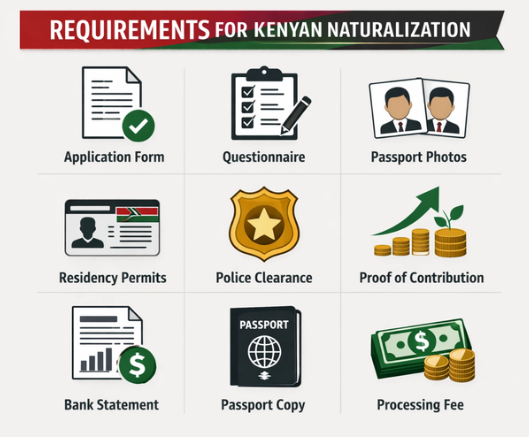
1. Duly completed application Form (10) attested to by a Commissioner for Oaths. This form is available on the eFNS portal.
2. Duly filled Questionnaire.
3. Passport size photographs.
4. Copies of Permits held for the last 7 years or the number of years the applicant has resided in Kenya.
5. Original certificate of good conduct/Police Clearance Certificate.
6. Letter of proof of contribution made in national development.
7. Personal Bank statement.
8. Passport Copy.
9. Application processing Fee – Kshs. 20,000/=.

Important Note: Section 13(2) of the Kenya Citizenship and Immigration Act provides that the Cabinet Secretary cannot register an applicant if the applicant’s country is at war with Kenya at the date of making the
application.
The Process of Naturalization
Step 1: Create an Account
This step involves creating an account
with the Kenyan electronic Foreign
Nationals Services (eFNS) portal which is
under the Department of Immigration
Services or an e-citizen account.
Step 2: Log-in
Log into the eFNS account and select the “Apply now” link
Step3: Application
Click on the “Submit Applications” tab and select the Lawful Residence tab. After the application is processed, an invoice will be generated which can be seen by clicking on “Dashboard” then “Payments” Tab. You shall receive automatic notifications via email and on your online account about the progress of your application.
Step 4: Background checks
Under this process, the department of immigration conducts criminal background, immigration history and
any security.
Step 5: Interview and Evaluation
Applicants are invited for interviews where they are tested on their knowledge about Kenya and the language.
Step 6: Decision by the Cabinet
Secretary The Cabinet Secretary exercises discretion to approve or reject the application.

Step 7: Oath of Allegiance
Upon approval, the applicant takes the oath of allegiance.
Step 8: Issuance of Certificate of Naturalization
A Certificate of Naturalization is issued, officially conferring Kenyan citizenship.

Conclusion
Citizenship by naturalization in Kenya is a carefully regulated process grounded in constitutional and statutory law. By requiring lawful residence, good character, cultural integration, and allegiance to the Republic, the law
ensures that naturalized citizens are genuinely committed to Kenya’s values and future. The process of naturalization is extremely thorough however, successful applicants are given full citizenship rights and responsibilities.

Our Team at ESK Advocates LLP is equipped with the knowledge and extensive network to assist foreign clients in the process of acquiring Kenyan citizenship through naturalization; from filling out the relevant forms,
procuring the requisite documents to interview preparation. Visit our office or call the number below for further assistance. Article by : Joyce Nduta Holding-Over Associate

Screenshot from 2026-04-18 16-53-11

VAT AND THE DIGITAL ECONOMY IN KENYA

WHAT THE SENDY LTD HIGH COURT CASE MEANS FOR DIGITAL PLATFORMS & BUSINESSES

INTRODUCTION

Technology has greatly evolved, and with such, digital platforms have transformed how business is done in Kenya and beyond. Many businesses now fully operate on digital platforms, whereby their business models involve providing services without owning physical assets, yet they play a critical role in connecting customers,
service providers, and payments. As these business models have grown, so too have questions around Value Added Tax (VAT). The drafters of the Value Added Tax Act (Cap 476) designed the provisions therein
with tangible goods and identifiable services in mind. However, applying the said provisions to digital platforms has proved to be more complex.

Recent decisions from the Tax Appeals Tribunal and the High Court have shown the complexity of applying provisions of the VAT Act on digital platforms. This article explores how VAT works in general, why digital platforms present unique challenges, and what recent decisions from the tribunal and the High Court mean for businesses operating in Kenya’s digital economy.

WHAT IS VAT AS PROVIDED BY LAW?

VAT in Kenya (as per the Value Added Tax Act Cap. 476) is a consumption tax imposed on the supply of goods and services. Although businesses are required to collect and remit VAT, the tax is ultimately borne by the end consumer.

When a VAT-registered business sells goods or services, it adds VAT to the selling price (this is called output VAT). The business can also claim back the VAT it has paid on its own business purchases and
expenses (this is called input VAT). The business then remits the difference between the VAT it collected and the VAT it paid. For VAT to apply, three basic conditions must be met:

1. There must be a supply of goods or services.
2. The supply must be made by a person or business registered (or required to be registered) for VAT.
The supply must be made in the course of doing business in Kenya.


This sounds simple, but more often than not, problems can arise in practice. Sometimes it is not clear whether a supply has actually been made, who is making the supply, or what exactly is being supplied.
This is especially common in business models, such as digital platforms, as explained below.

WHY DIGITAL PLATFORMS
TRADITIONAL VAT THINKING
CHALLENGE

The reason why applying the traditional rules of VAT on digital platforms is complex is that most of these digital platforms only act as intermediaries. They act as “middlemen” connecting consumers to service providers. They only provide the technology to facilitate the transactions, and in many instances, they are not the ones who provide the actual services. Take for example, the common digital platforms only to the platform’s commission or service fee? Who is responsible for accounting for VAT in the overall transaction?
These questions have raised disputes with the Taxman, who in most instances takes a broad interpretation in relation to payable VAT. Recent court decisions have now provided the much needed guidance on such disputes.

DECISIONS EMERGING FROM THE COURTS

In a recent High Court decision in Commissioner of Domestic Taxes v Sendy Limited (Income Tax Appeal E137 of 2024) [2025] KEHC 14814 (KLR), the court clarified instances where digital platforms may be deemed to be principal suppliers for VAT purposes, therefore liable for VAT on the full transaction paid by the customer rather than just the commission or service fee. like “Uber”, “Airbnb”, “Jumia”, just to name but a few.

Background This unique situation raises important questions. Is the platform supplying a service to the customer, or is it simply enabling a transaction between third parties? Should VAT apply to the full value
of the transaction, or Sendy Limited (Respondent) operated a digital marketplace for delivery services
connecting third-party customers with independent transporters.

According to the Respondent, the transport services were provided by the third-party suppliers, and the Respondent’s income was limited to its commissions charged to the transporters for the use of its platform.


In its case before the Tax Appeals Tribunal, the Respondent showed its audited financial statements,
sample commission agreements with transporters, and witness testimony to support its assertion that it had
accounted for the VAT on its commissions. Additionally, the Respondent had earlier received a private ruling from the Appellant that the Respondent was liable for VAT only on its commissions. The Tribunal ruled in the
Respondent’s favor, finding that it did not provide transport services.

The Commissioner of Domestic Taxes (Appellant), on the other hand, stated that the Respondent was the principal supplier of the transport services. According to the Appellant, the Respondent exercised significant control over the services provided on its platform. The Respondent controlled the customer relationship
through its digital application, dispatched the nearest available driver, determined the price, issued the demand for payment, and, most importantly, received full payment for the services.

The Appellant therefore argued that the Respondent was liable for VAT on all fees collected from the customers, not just from commission. Determination The main issue for determination was whether the Tribunal erred in concluding that the Respondent was not supplying transport services. In addressing this issue, the court examined section 5 of the VAT Act and noted that the Act provides for a broad definition for supply of goods, but it does not establish specific criteria for identifying the supplier in intricate, multi-party arrangements conducted through digital platforms.

In the absence of specific provision under our domestic laws, the court turned to jurisprudence arising from the Court of Justice of the European Union (CJEU) under the harmonized EU VAT framework. A foundational principle in EU VAT Law is that the characterization of a transaction must be based on its objective characteristics, reflecting its economic and commercial reality.

It considered Article 28 of the EU VAT Directive, which stipulates that an intermediary acting in its own name but on behalf of another is treated as having both received and supplied the underlying service. The court reviewed several CJEU authorities, including a decision establishing that a digital platform is presumed to act in its own name and thus to be the deemed supplier, where it participates in the supply. The CJEU further held that this presumption becomes conclusive where the platform either;

(i) authorizes the charge to the customer or the delivery of the service, or
(ii) determines the general terms and conditions of the supply. In short, the degree of control a platform
exercises over the underlying supply is the critical determinant. As such, the High Court overturned the
decision of the Tribunal and allowed the Appeal. It found that Sendy Ltd exercised substantial control
over the core components of the transaction by fixing prices, allocating drivers, and overseeing the invoicing and payment process. On that basis, the Court concluded that Sendy functioned as the principal supplier for VAT purposes.


With respect to the prior private ruling from the KRA, the court acknowledged that Section
65 of the Tax Procedures Act renders such rulings binding to the commissioner. However, it held that this binding effect does not diminish the judiciary’s constitutional mandate to interpret laws.

IMPLICATIONS OF THE JURISPRUDENCE FROM THE COURT
The emerging jurisprudence implies that VAT compliance for digital business requires meticulous planning. Their liability for VAT compliance is determined by their substantive role in the transactions rather than what they have labelled themselves. Therefore, businesses in the digital platform should regularly review their positions to ensure they are always compliant.

The decision also means that taxpayers might have to reconsider prior private rulings from the KRA, because while Section 65 of the Tax Procedures Act renders such rulings binding to the commissioner, the court stated that it cannot diminish the role of the Courts in interpreting the law.

HOW ESK ADVOCATES LLP CAN ASSIST
The Sendy Limited decision confirms that VAT liability in Kenya’s digital economy depends on economic
substance and operational control — not labels. Our Tax Law Practice helps digital platforms, fintech
companies, SMEs, and corporates assess and manage VAT risk with clarity and precision.

We assist with : VAT risk assessments for digital platforms Structuring marketplace and commission models
KRA objections, tax disputes, and appeals Private ruling applications and regulatory advisory
Proactive VAT compliance reviews If your business controls pricing, customer relationships, or payment flows, your VAT exposure may extend beyond commissions.


Screenshot from 2026-04-18 16-34-41

THE COLLAPSE OF UNITED INSURANCE: REGULATORY FAILURE, JUDICIAL REMEDY, AND THE IMPERATIVE OF LEGAL REPRESENTATION FOR POLICYHOLDERS

INTRODUCTION
Imagine paying your insurance premiums faithfully for years, only to find that when you need coverage
most, following an accident or liability claim, your insurer is insolvent. Worse, imagine being personally
exposed to court decrees and execution of your assets because the insurance company you trusted can
no longer meet its obligations.
This was the reality for hundreds of policyholders of United Insurance Company Limited. However, a
recent landmark judgment by the Court of Appeal at Nairobi in Civil Appeal No. 61 of 2014, Commissioner
of Insurance -vs- Kensilver Express Limited & 192 Others has set a powerful precedent for insurance
consumers in Kenya.


The Case That Changed the Landscape United Insurance Company Limited, a Kenyan motor vehicle insurer, faced liquidity crisis from 1999 onwards. The Insurance Company was in the business of issuing third party insurance policies in particular, to public service vehicles.

The Commissioner of Insurance was aware of the company’s deteriorating financial position from 1999 and he found that the major problem facing the company was failure to separate ownership of the company from its management. Over the years, the Commissioner took various administrative steps such as: facilitating management restructuring, directing asset sales, and attempting to negotiate with the insurer’s principals.
These efforts did not yield any fruits which eventually led to the company being placed under Statutory Management.

The Commissioner of Insurance with the approval of the Minister of Finance appointed Kenya Reinsurance Corporation (Kenya Re) as the Statutory Manager under Section 67C of the Insurance Act (Cap 487). On 18th July, 2005, Kenya Re declared a moratorium through the daily newspaper for a period of one year. This meant that the Insurance Company could not give legal representation to their clients and if Judgment was entered against them, they could not settle the decretal sum.

As a practical consequence, 193 Judgment Creditors, mostly motor vehicle accident victims or their  dependents had their court decrees frozen. The Judgment Debtors were forced to settle the decretal sums and those who were unable to do so, faced civil imprisonment. The policyholders approached the court, arguing that their constitutional rights to liberty and peaceful ownership of property were violated by the regulatory failure to

Findings from the
Court of Appeal Judgment

1. Regulatory Diligence is Mandatory 

The Court affirmed that the Commissioner of Insurance and the Minister of Finance have a statutory
duty to act with expediency and diligence in the public interest, and cannot sit on known financial
troubles of an insurer until it is too late. While the Court of Appeal noted the Commissioner had held
meetings to try and salvage United Insurance when it began showing signs of trouble in 1999, it
affirmed that delaying intervention while knowing an insurer is failing constitutes a breach of duty to
the public, as regulators must act before a collapse becomes inevitable.

Why It Matters to You:

•Preventive Protection: Regulators cannot wait until an insurer is completely insolvent
before stepping in. If the Commissioner of Insurance delays intervention while knowing
an insurer is distressed, policyholders left exposed during that delay may have grounds
for recourse.

•Continuity of Cover: The law expects regulators to prioritize the continuity of insurance
cover for the public. If regulatory delay leaves you uninsured against third-party claims,
the state may bear responsibility for the gap.

2. Government Liability for the Compensation Fund Perhaps the most significant holding for consumers was regarding the Policyholders Compensation Fund (PCF). The Court held that the Government was responsible for losses suffered due to the failure to operationalize the PCF because it exists specifically to cushion policyholders when insurers become insolvent or when they are under Statutory Management. Although the
Fund existed in law since 1985, it was not operational until 2005. The Court ruled that this delay violated policyholders’ rights.

Why It Matters to You:

•State Liability: While the Policyholders Compensation Fund is now active, this judgment establishes that the Fund exists to protect you, not to create hurdles. The Insurance Act provides that the Policy-holders Compensation Fund shall provide compensation to the claimants of insurer placed under a manager or whose license has been cancelled under the Act

•Safety Net Enforcement: The Court affirmed that the Fund’s purpose is to compensate policyholders of insolvent insurers. This strengthens your legal position when filing claims against the PCF for Xplico or Invesco policies. It is a statutory right.


3. Constitutional Rights

Trump Administrative Moratoriums The judgment reinforces that administrative measures like moratoriums and statutory management cannot indefinitely violate fundamental constitutional rights to liberty and peaceful ownership of property. The case arose because policyholders were facing execution of decrees, seizure of assets, and even civil imprisonment because their insurer could not pay third-party claims during the moratorium.
The Court recognized that while regulators may implement temporary protective measures to address
insolvency, these measures cannot leave policyholders indefinitely vulnerable to enforcement actions or strip them of constitutional protections. The balance between administrative convenience and individual rights must ultimately favor the policyholder when the state has failed to prevent the collapse or provide timely alternative remedies.

Why It Matters to You:

•Protection from Personal Liability: If you held a valid third-party policy, you should not be personally liable for debts the insurance was meant to cover. If an insurer’s insolvency exposes you to personal execution, the law provides avenues to stay those proceedings.

• Human Rights Compliance:
The judgment affirms that policyholders cannot be subjected to civil jail merely because their insurer failed to meet its obligations. The High Courtreferenced United Nations Conventions prohibiting imprisonment for debt. A principle that remains persuasive authority for protecting insured persons from personal liberty violations arising from insurer insolvency


PRACTICAL LESSONS
EVERY POLICYHOLDER
SHOULD KNOW

From the Landmark Kensilver Judgment & the current Insurance Landscape
1. Verify Before You Buy4. Documentation Is Your Shield United Insurance had liquidity problems as early as
1999—but policyholders kept paying premiums unaware.
Always confirm your insurer’s licensing status and financial health via the Insurance Regulatory
Authority (IRA) portal before purchasing or renewing cover.The petitioners had to prove they were genuine
policyholders with valid contracts. The Court emphasized strict verification to eliminate fraud,
but also protected bona fide claimants.

2. Conflict of Interest in Statutory Management Is Unlawful
The Court held that Kenya Reinsurance Corporation ought not to have been appointed Statutory
Manager of United Insurance because, as a reinsurer, it was potentially a debtor to the insolvent
insurer therefore creating a real or potential conflict of interest.
The entity managing your insurer (e.g., PCF managing Xplico) must act solely in your interest and not to protect its own financial exposure. Any bias or conflict that delays or reduces your settlement is legally challengeable.

3. Your Cover Survives
Insurer Insolvency, if You Act The Court affirmed that policyholders retain enforceable rights under their insurance contracts even when the insurer is under statutory management. The moratorium suspends claims settlement however, it does not eliminate your cover. If your insurer is placed under Statutory Manage
ment or is insolvent, one can still get compensation through the Policyholders Compensation Fund
under Section 179 (1) of the Insurance Act (Cap 487) Your policy documents, premium receipts, claim
forms, and correspondence are critical evidence. Without them, even valid claims may be rejected.

5. Your Constitutional Rights Shield You from Personal Execution Policyholders cannot be indefinitely exposed to asset seizure or civil jail merely because their insurer failed to pay decretal sums in Judgments.
If you face personal liability due to an insurance company being placed under Statutory Manage-
ment or is insolvent therefore unable to pay decretal sums owed, seek urgent legal intervention to
stay execution proceedings.

How ESK Advocates LLP Can Help

Navigating insurance insolvency, statutory management, and claims against the Policyholders
Compensation Fund requires specialized legal expertise. The legal framework is complex, and
insurance companies often rely on technicalities to deny claims.

Don’t let insurance failure compromise your future. The law is on your side, but you need the right
advocates to enforce it. The Commissioner of Insurance v Kensilver Express Limited judgment
proves that with diligent legal representation, your rights can be protected. If you are facing challenges with an insurance claim, an insolvent insurer, or regulatory disputes, contact us today for a consultation.