THE EMERGING POSITION OF THE SUPERIOR COURTS
Introduction
The law governing matrimonial property in Kenya has undergone significant transformation over the last decade, largely through interpretation of Article 45(3) of the Constitution, the Matrimonial Property Act, 2013, and the Marriage Act, 2014. The Constitution guarantees equality of rights between spouses during marriage and upon its dissolution, and it is because of this provision that Kenyan courts have had to grapple with the question of whether such equality translates into equal ownership and automatic equal division of matrimonial property.
Recent decisions of the Supreme Court and the Court of Appeal have clarified several contentious aspects of matrimonial property law, including the meaning of contribution, the effect of non-monetary contribution, the status of cohabitees, the retrospective application of the Matrimonial Property Act, and the principles governing apportionment of matrimonial property. The jurisprudence reveals a gradual movement away from the notion of automatic equal sharing and towards a contribution based on equity and fairness.
Constitutional and Statutory Framework Article 45(3)
of the Constitution provides that parties to a marriage are entitled to equal rights at the time of marriage, during marriage, and at the dissolution of marriage. The Matrimonial Property Act, 2013, was enacted to operationalise these constitutional guarantees. Of particular importance are:
Section 2, which recognizes both monetary and non-monetary contributions. The Act recognizes nonmonetary contributions, including:
a. Domestic work and management of the matrimonial home;
b. Child care;
c. Companionship;
d. Management of family businesses or property; and
e. Farm work. Section 6, which defines matrimonial property;
Section 7, which provides that ownership vests in spouses according to their contribution;
Section 14, which establishes rebuttable presumptions concerning property registered in the name of one or both spouses. The issue that the courts have been called upon to adjudicate has been reconciling Article 45(3)’s guarantee of equality with Section 7’s requirement that division be based on contribution

The Supreme Court’s Landmark Decision in JOO v MBO

The most influential modern authority is the Supreme Court decision in JOO v MBO & 2 others (Petition 11 of 2020) [2023] KESC 4 (KLR). In that case, the Court was called upon to determine whether matrimonial property should automatically be divided equally upon dissolution of marriage. The Court rejected the proposition that Article 45(3) creates a constitutional entitlement to a 50:50 division of matrimonial property. Instead, it held that equality of spouses does not equate to equality of interests in property rights. The Court stated that matrimonial property must be distributed according to the proven contribution of each spouse.
The Supreme Court further held that:
1. Article 45(3) guarantees equality of rights, not equal ownership of property.
2. Matrimonial property disputes must be determined on a case-by-case basis.
3. Courts must evaluate both monetary and non-monetary contributions.
4. There is no universal formula for the division of matrimonial property.
5.Evidence of contribution remains the essence of entitlement.
The decision effectively endorsed the contribution-based approach previously explained by the Court of Appeal in Echaria v Echaria (Civil Appeal 75 of 2001) [2007] KECA 504 (KLR). Although decided before the 2010 Constitution and the Matrimonial Property Act, Echaria continues to have considerable influence. This decision established the principle that a spouse claiming a share in matrimonial property must prove contribution to its acquisition. The Court rejected the English presumption of automatic beneficial ownership and insisted on proof of actual contribution.
Recognition of Non-Monetary Contribution

Despite rejecting automatic equal division, the Supreme Court has also enhanced recognition of non-monetary contributions. The Supreme Court acknowledged that contribution extends beyond direct financial input and includes domestic labour, child care, companionship, management of family affairs, and other forms of indirect support that enable wealth creation within the marriage.
This recognition is particularly important because many spouses, especially women, may not contribute directly to acquisition through income but facilitate the accumulation of family wealth through unpaid domestic and caregiving work. Accordingly, the current position is not that only financial contributions matter; rather, all forms of contribution matter, provided they can be demonstrated through evidence.

Presumption of Constructive Trusts
Marriage and A significant development emerged from the Supreme Court’s decision in MNK v POM & another (Petition 9 of 2021) [2023] KESC 2 (KLR). The Court held that the presumption of marriage as cohabitees remains an exception rather than the rule and should not readily be invoked merely because parties cohabited for a long period. The Court found that no marriage could be presumed in the circumstances of that case. However, the Court proceeded to recognize a constructive trust arising from the parties’ common intention and joint contribution to the acquisition and improvement of property. It consequently apportioned the property in the ratio of 70:30.
This decision demonstrates an important shift in that where a matrimonial claim fails due to absence of a legally recognizable marriage, equitable doctrines such as constructive trust and resulting trust may still provide relief where contribution is established.
Retrospective Application Matrimonial Property Act
Another issue addressed by the Supreme Court in the JOO v MBO case concerns the application of the Matrimonial Property Act, 2013. The Court held that the Act does not apply retrospectively to disputes whose causes of action arose before its commencement. Such disputes continue to be governed by the repealed Married Women’s Property Act, 1882, and other applicable constitutional principles.
However, the Court has clarified that constitutional values provided for in Article 45(3) may still inform the basis of the interpretation of pre-2013 disputes.
Matrimonial Property Corporate Structures
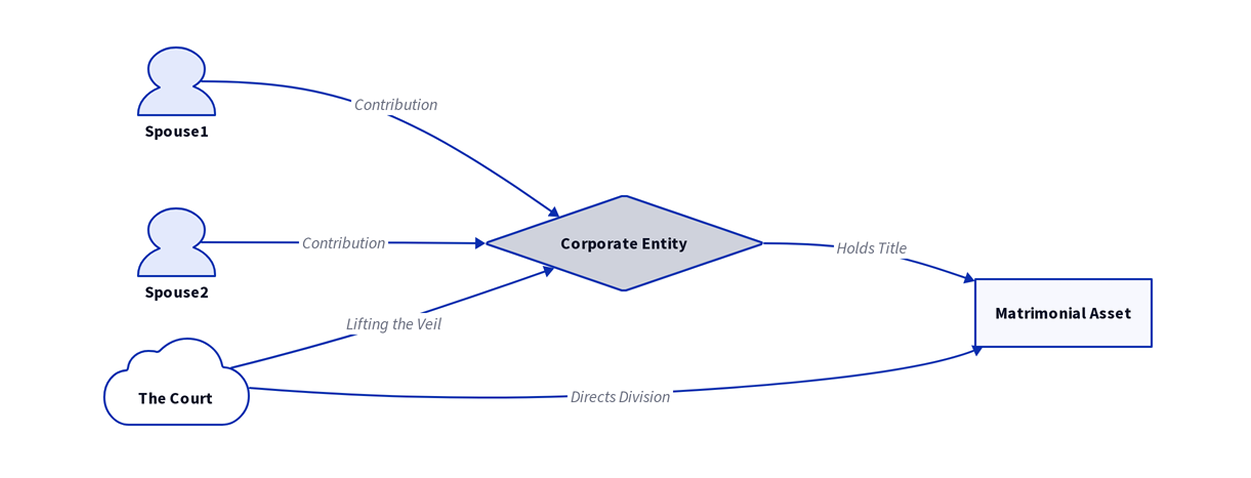
Held Through Recent Court of Appeal jurisprudence has also expanded the scope of matrimonial property by recognizing that spouses cannot evade matrimonial property claims merely by placing assets under corporate entities. Where shares or corporate assets are acquired during marriage and evidence demonstrates contribution by both spouses, courts have shown wilingness to look beyond the corporate veil. This development prevents the use of companies for defeating legitimate matrimonial property claims. This was explained by the Court of Appeal in GKW v RNK (Civil Appeal 605 of 2019) [2025] KECA 1475 (KLR) which held as folows.
“This Court in Lacheka Lubricants Ltd & Another v Chanandin & 4 Others (supra) went on to state:
“41.We are totally in agreement with the reasoning of the Court in PWK v JKG (supra). It would be totally unjust and unfair to deny the court jurisdiction to deal with a dispute involving distribution of matrimonial property, where the ownership of the claimed property is obfuscated through transfer of the property to a company which is either wholly controlled by the husband and wife as sole directors and shareholders, or by the husband as the main shareholder. In such situations, the corporate legal personality of the company is either obscured or deliberately ignored by the couple during coverture, and this requires the court to go behind the corporate veil to determine the actual beneficial ownership of the property. As stated in Muthembwa v Muthembwa (supra), section 17 of the Married Women’s Property Act gives the court wide powers to inquire into the company and the issue of ownership of the property and to make orders as the justice of the case may demand.” (Emphasis added)”
Conclusion and Emerging Principles
In conclusion, several clear principles can now be deduced from the recent decisions of the superior courts:
1. No Automatic 50:50 Division Article 45(3) guarantees equality of rights, not automatic equal ownership of matrimonial property.
2. Contribution Remains the Governing Test Distribution is determined according to the contribution of each spouse, whether monetary or non-monetary.
3. Non-Monetary Contribution Has Equal Legal Recognition Domestic work, child care, companionship, and management of family affairs are legally recognized contributions.
4. Each Case Depends on Its Facts No fixed formula exists for the distribution of Matrimonial Property. Courts have broad discretion to assess based on the evidence presented.
5. Equitable Remedies Remain Available Constructive trusts and resulting trusts continue to provide relief even where a formal marriage is absent. However, this is an exception rather than the general rule 6. Documentary Evidence Is Crucial Parties must keep records demonstrating both direct and indirect contribution to acquisition, development, or preservation of matrimonial assets.
How ESK Advocates LLP Can Assist
Matrimonial property disputes are among the most emotionally charged disputes in courts. As recent jurisprudence has shown, the outcome of such disputes depends on the quality of evidence presented regarding monetary and non-monetary contributions and the strategic application of various relevant legal principles. As ESK Advocates LLP, we are your best legal partner in such matters. At ESK Advocates LLP, we do not merely litigate such disputes but, most importantly, help clients protect what they have built and preserve what matters most.
Article By: Charles Chahilu
Associate Advocate