Introduction

Family trusts have emerged as one of the most significant developments in wealth management and succession planning in Kenya. Kenya’s trust law operates within a multi-layered statutory framework. The Trustee Act, Cap. 167, remains the primary legislation regulating trustees’ powers, their appointment and removal from the positions. The Trustees (Perpetual Succession) Act, Cap. 164 facilitates the incorporation of trusts and defines the parameters of family trusts. It is worth noting that the current legal framework governing Trusts, built on colonial-era legislation, has long been recognised as inadequate for modern wealth management needs. Thus, the Trust Administration Bill, 2025, currently under consideration in Parliament, proposes to repeal both the Trustee Act and the Trustees (Perpetual Succession) Act and introduce a unified, transparent, framework.

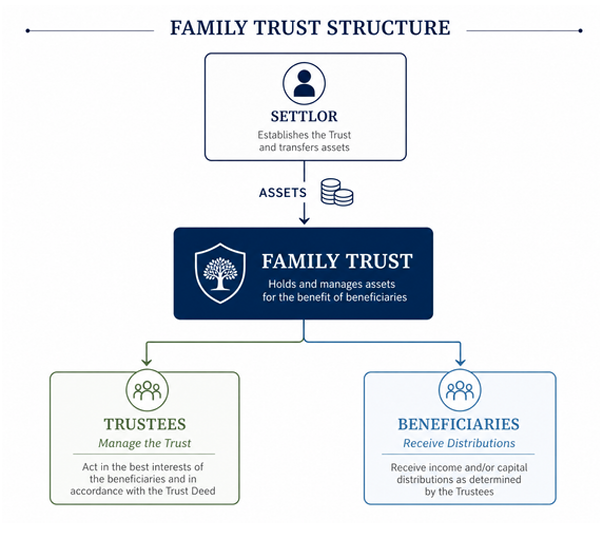
Family trusts offer structured mechanisms for preserving wealth across generations and ensuring orderly succession outside the often protracted probate process. However, the very features that make family trusts attractive including flexibility, privacy, and asset protection, also create vulnerabilities that can be exploited. This article examines the principal loopholes in Kenya’s family trust regime and the legal remedies available to address them.
Loopholes in Kenya’s Family Trust Regime
a) Uncertain or Vague Trust Instruments
For a trust to be legally valid under Kenyan law, the trust instrument must satisfy three fundamental certainties: certainty of intention, certainty of objects (beneficiaries), and certainty of subject matter (trust property). These requirements, rooted in English common law serve as the bedrock upon which all valid trusts are constructed. Failure to meet any one of these certainties renders the trust invalid. The Trustees (Perpetual Succession) Act (Cap. 164) explicitly provides that a trust will not be valid if the terms of the trust are so uncertain as to render performance impossible.

Certainty of intention requires that the settlor’s clear and unequivocal intention to create a trust and transfer ownership of assets to trustees for the benefit of beneficiaries must be ascertainable from the trust deed. Where the intention is in doubt, the trust may be deemed a sham. Certainty of objects demands that the trustees be able to make a full and definitive list of beneficiaries at all times; if the beneficiaries are unascertainable, the trust fails due to uncertainty of objects. Certainty of subject matter requires that the trust deed clearly identify and list the assets constituting the trust property
Therefore, poorly drafted, ambiguous, or vague trust deeds can be exploited in several ways. A settlor seeking to retain control or obscure the true nature of the trust may deliberately craft vague provisions. Alternatively, trustees may exploit ambiguity to justify actions that benefit themselves or select certain beneficiaries at the expense of others. Beneficiaries, conversely, may challenge the trust on grounds of uncertainty to have it invalidated or force a redistribution of assets. In the case of In re Estate of Chadrakant Devchand Meghji Shah (Deceased) [2017] KEHC 8812 (KLR), the deceased made a will that created a testamentary trust by stating that the executors of his will should hold his estate for the benefit of his son and daughter.
However, the trust failed to indicate the assets that will constitute the trust fund and consequently it was unclear the amount of income that was to be obtained from the trust. The court found that even though there was certainty of intention and objects of the trust, the trust lacked certainty of subject matter and therefore the trust was held to be null and void.
Where a trust deed is found to be uncertain or vague, the trust may be declared invalid. A trust that fails due to uncertainty also loses the tax exemptions available under the Income Tax Act and Stamp Duty Act, exposing the assets to significant tax liabilities. Fundamentally, uncertainty invites litigation, as beneficiaries, trustees, and creditors dispute the interpretation of vague provisions. Lastly, vague trust deeds may grant trustees excessive discretion which can be abused to favour certain beneficiaries or to justify actions that do not align with the purposes of the trust.
The remedy for this loophole lies under Section 62 of the Trustee Act, Cap. 167 where the court has power to vary trusts in limited instances. However, where uncertainty is so profound as to render performance of a trust impossible, any interested party including beneficiaries, trustees or creditors, may apply to the court for a declaration that the trust is invalid and the court will exercise its discretionary powers in granting the orders.
a) Broad and Absolute Discretion of the Trustees One of the most significant loopholes in family trusts is the broad discretion often conferred upon trustees under trust deeds which in many cases is usually absolute leaving beneficiaries with limited ability to challenge the trustees’ actions. While such discretion is intended to enable trustees to administer trust assets efficiently and respond to changing circumstances, it can be abused

Trustees may make major decisions concerning trust property, investments or distributions without adequate consultation or disclosure to the beneficiaries. Although the Trustee Act grants trustees powers relating to investment, sale of trust assets, and management of trust property, it does not immunize bad faith where it arises among trustees. Trustees remain bound by fiduciary obligations to act in good faith, avoid conflicts of interest, exercise their powers for proper purposes, keep accurate accounts, and administer the trust strictly in accordance with the trust deed and the law.
The landmark case of Albert Kigera Karume & 2 Others v. George Ngugi Waireri & 2 Others (Milimani Civil Case No. 125 of 2015) offers a seminal judicial exposition of this loophole.
In that dispute, some beneficiaries of the late Njenga Karume’s multi-billion-shilling family trust accused the trustees of mismanagement, lack of transparency, failure to account for trust assets, exclusion of beneficiaries from information concerning the trust, and disregard of their welfare. While the High Court firmly upheld the validity of the trust structure and affirmed the founder’s right to appoint trustees of his choice, the Court emphasized that trustees are not beyond scrutiny merely because they possess wide discretionary powers. Justice Roselyn Aburili underscored that trustees are accountable to beneficiaries and must administer trust property diligently, transparently, impartially, and solely in the interests of the beneficiaries.
The Court ultimately ordered the removal of the trustees following the trust deed’s procedural mechanisms. The decision demonstrates that the remedy for abuse of trustee discretion is not the dissolution of the trust or transfer of trust assets directly to beneficiaries, as that would defeat the settlor’s intention. Rather, courts will intervene to enforce fiduciary duties, compel disclosure and accounting, and where necessary remove and replace trustees who have failed in their obligations. Beneficiaries can thus apply to the court for the removal of trustees who have breached their fiduciary duties.
a) Lack of Beneficiary and Dependants Protections
The intersection of Kenya’s family trust regime with matrimonial property and succession law reveals a significant loophole. Trusts can be strategicaly employed to disinherit spouses and dependants, effectively circumventing statutory protections.

Family trusts are increasingly utilised as estateplanning vehicles to facilitate intergenerational wealth transfer while avoiding the delays and publicity associated with probate proceedings. However, by transferring assets into a family trust during their lifetime, settlors can effectively disinherit heirs who would otherwise be entitled to a share of their estate. Section 26 of the Law of Succession Act provides for dependency provisions, but only against the deceased’s estate. Assets held in trust generaly fal outside the estate, so dependency claims may not reach them. This creates the possibility of spouses, children, and other dependants being deprived of property that would otherwise be available for distribution or for reasonable provision under succession proceedings.
Moreover, Section 6(2) of the Matrimonial Property Act, Cap. 152 expressly provides that trust property does not form part of matrimonial property. This statutory exclusion creates a powerful shield for assets placed in a family trust, as such property falls outside the scope of matrimonial property that would otherwise be subject to division upon divorce or dissolution While this provision is intended to preserve the integrity and independence of trusts, it also creates a potential avenue for abuse. A spouse may strategically transfer assets acquired during marriage into a family trust, thus placing them beyond the reach of the other spouse in the event of divorce or separation.
The PBO Act provides PBORA with enforcement powers across a tiered range of sanctions. Depending on the nature and severity of the non-compliance, an organization may face the issuance of compliance notices and corrective directives, financial penalties for late filing or failure to maintain records, suspension of operations pending investigation, cancellation of registration effectively shutting down the Organization, or personal liability for directors and officers in cases of gross misconduct.
A spouse or other dependent may challenge a trust as a sham or fraudulent conveyance where it was created to defeat their legitimate claims. In such cases, Courts are prepared to look beyond the formal structure of a trust where there is evidence that it has been established or utilised as a vehicle for fraud or to deliberately defeat of statutory rights. Thus, while placing assets in a trust can shield them from matrimonial property claims under the Matrimonial Property Act, the drafting must be robust enough to withstand a challenge that the trust was a sham or fraudulent conveyance.
A well-drafted trust deed should expressly acknowledge the interests of spouses and dependants and incorporate safeguards to prevent the trust from becoming an instrument of disinheritance. There should be full disclosure of any matrimonial property transferred into the trust and evidence of spousal knowledge or consent before such transfer is effected. This reduces the likelihood of subsequent claims that trust assets were improperly removed from the matrimonial estate. For dependants’ protection, the deed can provide for future children and dependants as beneficiaries.
Conclusion
Family trusts have become an indispensable tool for wealth preservation, succession planning, and asset management in Kenya’s increasingly sophisticated economic landscape. However, as this discussion demonstrates, the flexibility, privacy, and asset-protection benefits that make trusts attractive also create opportunities for abuse through vague trust instruments, excessive trustee discretion, and the potential exclusion of spouses and dependants from assets that would otherwise attract statutory protection The challenge for Kenyan law is therefore to ensure that they operate within a framework of transparency, accountability, and fairness. Through careful drafting, effective trustee oversight, robust beneficiary protections, and vigilant judicial intervention where abuses arise, trusts can continue to serve their legitimate estate-planning objectives while safeguarding the rights and interests of beneficiaries, spouses, dependants, and future generations. Ultimately, the continued development of Kenyan trust jurisprudence, coupled with the proposed reforms under the Trust Administration Bill, 2025, presents an opportunity to strike a balanced framework that promotes both wealth preservation and equitable justice.

Disclaimer : This publication is for informational purposes only and does not constitute legal advice. For tailored legal support , kindly consult our team.
Article By: Frankline Ojanji
Associate Advocate