

A Critical Analysis of Sections 97 and 98 of the Evidence Act in I & M Bank Limited v Buzeki Enterprises Limited (2026)
Abstract
The 2026 decision of the High Court of Kenya in I & M Bank Limited v Buzeki Enterprises Limited delivered on 13th February 2026 represents a significant reaffirmation of the parol evidence rule under Sections 97 and 98 of the Evidence Act (Cap 80). Although arising from enforcement of a promissory note, the judgment offers broader doctrinal clarification on the admissibility of oral evidence in the face of written commercial instruments. This note examines the Court’s interpretation of Sections 97 and 98, its narrowing of the “condition precedent” exception, and the implications of the decision for evidentiary certainty in commercial litigation. It argues that the ruling reflects a deliberate judicial preference for documentary supremacy and commercial predictability over equitable flexibility

Definition of the Parol Evidence Rule
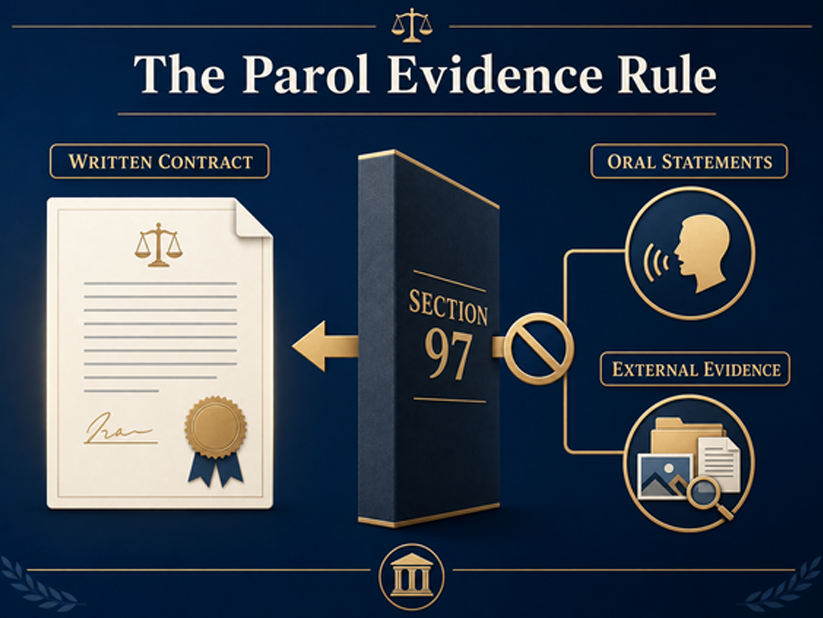
The parol evidence rule is a principle of contract and evidence law which provides that where parties have reduced their agreement into writing, oral statements or other outside evidence are not admissible to contradict, vary, add to, or subtract from the terms of the written document.
The rule rests on the presumption that the written instrument embodies the final and complete expression of the parties’ intentions. Accordingly, once contractual terms are formally recorded, the document itself becomes the exclusive source of proof of those terms, subject only to limited statutory or common law exceptions such as fraud, mistake, or the existence of a collateral agreement. In Kenya, the rule is codified in Sections 97 and 98 of the Evidence Act (Cap 80), which govern the admissibility of oral evidence in relation to written contracts.
The decision of the High Court of Kenya in I & M Bank Limited v Buzeki Enterprises Limited (2026) provides a modern judicial exposition of Sections 97 and 98 of the Evidence Act (Cap 80). While framed as a commercial dispute concerning enforcement of a promissory note, the case is fundamentally lay a straightforward but doctrinally significant question: “Can oral evidence be admitted to vary the express terms of a written negotiable instrument?” The Court answered firmly in the negative. In doing so, it reaffirmed the centrality of the parol evidence rule in Kenyan jurisprudence and clarified the limited scope of its statutory exceptions.
Section 97 and the Statutory Entrenchment of the Parol Evidence Rule The Structure of Section 97
Any business introducing an AI system likely to displace workers must conduct a workforce impact implement reskilling assessment programs collaboration with government agencies. This applies to any employer automating functions that affect existing roles. Section 97(1) of the Evidence Act provides that where the terms of a contract have been reduced into writing, no evidence shall be given in proof of those terms except the document itself or admissible secondary evidence of its contents. Section 97(2) goes further and prohibits the admission of oral evidence to contradict, vary, add to, or subtract from the written terms. This provision codifies the common law parol evidence rule and rests upon three foundational assumptions: 1. A written agreement embodies the final intention of the parties. 2. Documentary evidence is inherently more reliable than oral recollection. 3. Commercial stability depends upon certainty of written obligations. Section 97 therefore serves both evidentiary and policy functions.
Application in the Case
In I & M Bank v Buzeki, the Defendant argued that payment under a promissory note was conditional upon the sale of a parcel of land known as “Taru Ranch.” The written instrument, however, was clear and unequivocal. It specified: · A fixed principal sum; · A fixed maturity date; · An unconditional promise to pay. The Defendant sought to introduce oral testimony to demonstrate that repayment would only crystallize upon sale of the property.

The Court rejected this attempt and held that admitting such evidence would directly contradict the fixed maturity date and transform the nature of the instrument from unconditional to contingent. Under Section 97, the written document was conclusive proof of its terms. The evidentiary inquiry ended with the document itself. The judgment thus affirms that Section 97 is not a mere technical rule of exclusion; it is a structural doctrine safeguarding the integrity of written agreements.
Section 98 and the Limits of Flexibility The Provisos to Section 98
Section 98 introduces exceptions to the rigidity of Section 97. Oral evidence may be admitted to prove: Fraud Mistake Illegality Failure of consideration A separate oral agreement not inconsistent with the written contract A condition precedent These provisos ensure that the parol evidence rule does not operate as an instrument of injustice. However, they are carefully circumscribed.

The Defendant relied, implicitly, on the proviso permitting proof of a condition precedent but the Court drew a crucial doctrinal distinction. A valid condition precedent must operate consistently with the written contract. It cannot negate or contradict its express terms.The alleged oral condition in this case was not collateral or explanatory. It directly displaced the fixed maturity date and sought to introduce an uncertain contingency. The Court concluded that the oral evidence was inconsistent with the written instrument and fell outside the protective scope of Section 98. This interpretation narrows the practical operation of the condition precedent exception and reinforces the primacy of documentary clarity in commercial contexts.
Documentary Supremacy in Commercial Transactions
An important dimension of the decision is its commercial context. The instrument in question was not an informal private agreement; it was a promissory note a negotiable instrument capable assignment and reliance by third parties. Allowing oral conditions to modify such an instrument would introduce uncertainty into commercial finance and undermine negotiability.
The Court’s strict application of Sections 97 and 98 reflects an appreciation of this commercial reality. Evidence law, in this instance, serves a systemic function: Protecting financial predictability; Preserving reliance on written instruments; Preventing opportunistic litigation defences. The decision thus situates Sections 97 and 98 within a broader policy framework of commercial certainty.

Pleadings, Discipline Proof, and Evidentiary
Although primarily an interpretation of Sections 97 and 98, the judgment also reinforces the pleadings relationship and between admissibility.The Defendant’s reliance on an oral condition was not firmly grounded in the pleadings. The Court’s unwillingness to entertain that line of defence underscores a broader evidentiary principle. Issues for determination flow from pleadings, and evidence inconsistent with pleaded terms cannot be introduced to reshape the dispute. This procedural discipline complements the substantive rigidity of Section 97.
Critical Evaluation
APRIL 2026 eskadvocatesllp.co.ke The decision may be viewed as reflecting a formalist approach to contractual interpretation. Critics might argue that strict enforcement of documentary supremacy may sometimes subordinate equitable considerations.
However, in commercial litigation, particularly involving negotiable instruments, predictability often outweighs flexibility. The Court appears to have consciously prioritised systemic stability over case-specific accommodation.
From an evidence law perspective, the ruling clarifies that: · Section 97 establishes a strong presumption of documentary completeness. · Section 98 does not permit contradictions disguised as explanations. · Oral evidence cannot be used to rewrite clear written obligations. The case therefore strengthens doctrinal coherence in Kenyan evidence jurisprudence.

Conclusion
I & M Bank Limited v Buzeki Enterprises Limited stands as a contemporary reaffirmation of the parol evidence rule in Kenya. Daniel Munyoki Article By : Associate Advocate The High Court demonstrated that: Written contracts are conclusively proved by the document itself under Section 97. The exceptions in Section 98 are narrow and cannot be invoked to contradict express terms. In commercial litigation, documentary certainty is paramount. The decision reinforces the evidentiary hierarchy between written and oral proof and signals that courts will guard the integrity of commercial instruments with doctrinal firmness. As Kenyan commercial litigation continues to expand in complexity and volume, this case will likely serve as a leading authority on the operation of Sections 97 and 98 of the Evidence Act.
Article By:
Daniel Munyoki
Associate Advocate