
Screenshot from 2026-09-30 00-00-49

SPOTCHECK ON THE LAND ACT AND LAND REGISTRATION ACT: OVERLOOKED AND UNDERUTILISED STATUTORY PROVISIONS AND PRACTICE

THE ESK LEGAL BRIEF

SPOTCHECK ON THE LAND ACT AND LAND REGISTRATION ACT: OVERLOOKED AND UNDERUTILISED STATUTORY PROVISIONS AND PRACTICE

Introduction

Kenya’s land legal framework underwent a transformative overhaul with the enactment of the Land Act, 2012 and the Land Registration Act, 2012, both of which came into force on 2nd May 2012. These statutes were enacted to give effect to the land-related provisions of the Constitution of Kenya, 2010, particularly Articles 60 to 68, which articulate the principles of land policy, the classification of land and the institutional framework for land administration.

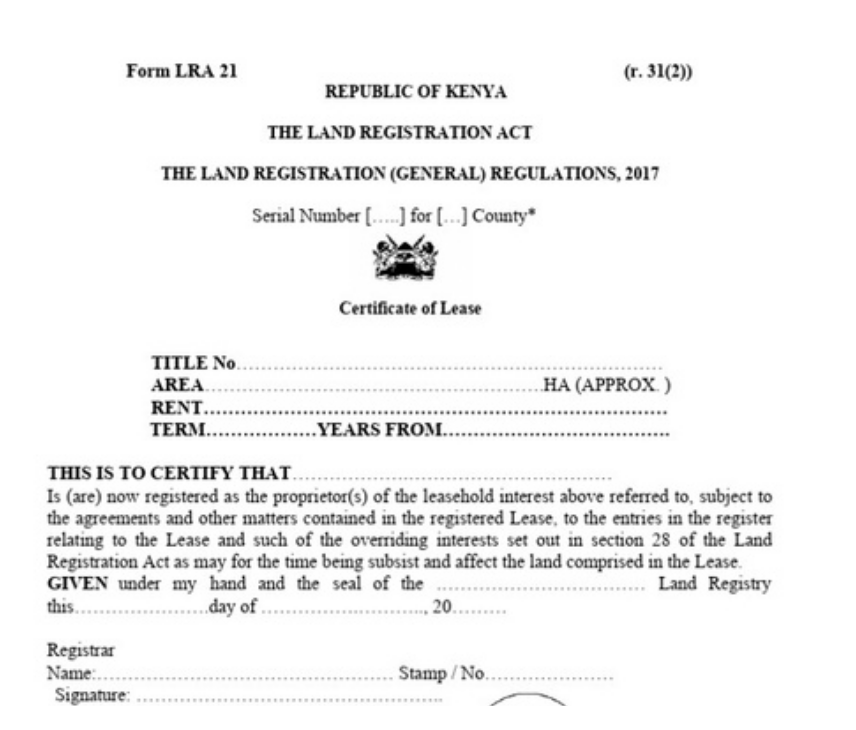
The Land Act provides the substantive framework for the management, administration and utilisation of land, including matters relating to leases, charges, compulsory acquisition, settlement programmes, easements and related interests. The Land Registration Act, on the other hand, establishes the framework for registration of interests in land, maintenance of land registers, protection of registered proprietors of land and regulation of dealings affecting registered land.

Yet, despite the comprehensive nature of these statutes, numerous provisions remain overlooked, underutilised or misunderstood in practice. Some provisions offer preventive remedies that can protect parties before a dispute escalates, while others provide procedural safeguards or avenues for administrative intervention that can avoid unnecessary litigation. This article undertakes a spotcheck of selected provisions of the two statutes, examining their purpose and practical significance to landowners, purchasers, lenders, developers and conveyance practitioners.

The Land Act, 2012

a) Sections 136-149: Easements and Analogous Rights – The Uncharted Territory

Part X of the Land Act provides a statutory framework for easements and analogous rights, including rights of way, wayleaves and communal rights of way.

An easement is essentially a non-possessory interest that enables a person to use another person’s land for a defined purpose or requires the owner of that land to tolerate or refrain from specified acts. Sections 138 onwards provide mechanisms for the creation and enforcement of easements and related rights, while other provisions address access, wayleaves and communal rights of way.

Why are these provisions often overlooked? Landlocked parcels of land, blocked access routes and disputes concerning utilities are common sources of land litigation. Notably, parties will often proceed directly to court without first considering whether the statutory mechanisms for establishing or enforcing an appropriate right of access are available.

What many don’t realise is that the statutory framework under the Land Act, can be particularly useful where: reasonable access; a neighbour refuses necessary access; public infrastructure such as electricity lines or pipelines requires a wayleave; a public or communal right of way is required; or adjoining landowners need to formalise an existing access arrangement.

The Land Act provides mechanisms through which these interests may be created, regulated and compensated where applicable. Therefore, developers and landowners should consider formalizing access rights rather than relying on informal arrangements. A properly registered easement can provide significantly greater certainty than an informal understanding between neighbours.

b) Section 13: Lessee’s Pre-emptive Rights to Allocation

Section 13 of the Land Act protects the immediate past lessee’s pre-emptive right to allocation where leasehold land reverts to the national or county government, subject to the statutory conditions, including Kenyan citizenship and the land not being required for a public purpose.

In Tenai v Sidhu & 5 Others [2025] KECA 105 (KLR), the Court of Appeal affirmed that the former lessee had a pre-emptive right and that this right could support a legitimate expectation that the lease would be renewed, particularly where the lessee had pursued renewal and the public authorities failed to properly process or explain the application.

Significantly, the Court found that the subsequent allocation to another party was made in violation of the former lessee’s legitimate expectation, noting that the expectation was consistent with the pre-emptive rights recognised under both the earlier land law regime and the Land Act.

The decision also carries an important due-diligence lesson for subsequent purchasers. A registered title is not necessarily the end of the inquiry where the root of title is challenged; the purchaser may need to establish the legality and regularity of the acquisition and satisfy the court that the title was acquired free from relevant interests.

The practical takeaway is that lease expiry should trigger action, not complacency. Lessees approaching expiry should make timely applications and maintain a clear documentary trail of their dealings with the relevant land authorities.

Conversely, persons seeking to acquire land previously held under a lease should investigate whether the former lessee has exercised or may assert a statutory pre-emptive right.

c) Sections 107-133: Compulsory Acquisition – The Overlooked Procedural Safeguards

The Land Act also provides the statutory framework governing compulsory acquisition of land for public purposes. Compulsory acquisition is an exercise of state power which directly interferes with an individual’s proprietary rights. Consequently, the Constitution and the Land Act prescribe procedural and substantive safeguards intended to protect affected proprietors.

Procedural compliance in this regard is key. The fact that land is required for a public project does not dispense with the statutory procedure. One of the important requirements is consultation with affected persons. Though often overlooked, Courts have recognized the importance of meaningful engagement with affected communities, particularly where government projects involve displacement or interference with occupation and livelihoods.

Therefore, landowners affected by compulsory acquisition should not just wait for the final decision of the acquisition. They should scrutinise the process from its commencement, including: whether the acquisition is for a lawful public purpose; whether the National Land Commission has followed the prescribed procedure; whether the required notices have been issued; whether affected persons have been given an opportunity to participate and give their views; whether valuation and compensation have been properly undertaken; and whether possession has been taken in accordance with the law.

Early legal intervention may be critical where procedural irregularities arise.

The Land Registration Act, 2012

a) Section 28: Overriding Interests – Interests Beyond the Register

One of the fundamental features of the Land Registration Act is that registration does not necessarily disclose every interest affecting land. Section 28 of the Act provides that registered land is subject to specified overriding interests, whether or not those interests are noted on the register. These include: trusts, including customary trusts; rights of way, rights of water and profits subsisting at first registration; natural rights of light, air, water and support; rights acquired or in the process of being acquired by prescription; and other rights provided under written law. Indeed, in Kiebia v M’lintari & another [2018] KESC 22 (KLR), the Supreme Court confirmed the legal recognition of customary trusts as overriding interests and explained that such trusts need not be noted on the register. Also recently, in Kariuki v Ringsview Apartment Ltd & another (Environment and Land Case Civil Suit E140 of 2021) [2026] KEELC 3463 (KLR), the Environment and Land Court upheld a constructive trust arising from an apartment unit that was fully paid up but the Vendor subsequently charged the mother title without notice to a financier, which though unregistered, qualified as an overriding interest within the meaning of Section 28 of the Land Registration Act and is therefore binding on the title.

The importance of Section 28 is that a purchaser or financier cannot always assume that an interest does not exist merely because it does not appear on the title. Due diligence by the purchaser or financier should therefore extend beyond the official search. Physical inspection of the land, inquiries from occupants, examination of family arrangements and investigation of the historical acquisition of the property may reveal interests that are not apparent from the register.

b) Section 79: Rectification by the Registrar – An Underutilised Remedy

Section 79 of the Land Registration Act provides mechanisms through which the Registrar may rectify the land register in circumstances permitted by the Act.

Administrative rectification can be useful where the issue is capable of being corrected without determination of a substantive dispute through litigation. Thus, before commencing court proceedings seeking cancellation or alteration of a title, one should first identify the nature of the alleged error. Where the issue falls within Section 79, approaching the Registrar may provide a faster and more proportionate remedy.

However, Section 79 should not be confused with the Court’s power under Section 80. In Paragon Electronics Limited v Chief Land Registrar & 2 others; Ngum & 2 others (Interested Parties) [2025] KEELC 3209 (KLR), the Court emphasised the limits of the Registrar’s power to rectify the register holding that it is only in non-contentious matters of an error which does not materially affect the interests of any proprietor and with the consent of all affected parties, that a Registrar can rectify the register pursuant to Section 79 of the Land Registration Act.

c) Sections 18-21: Boundaries – Prevention Rather Than Litigation

Boundary disputes are among the most common land disputes in Kenya yet the Land Registration Act provides mechanisms for dealing with boundaries before a dispute becomes a court case. Section 18 restricts the Court from entertaining proceedings concerning boundaries of registered land unless the boundaries have first been determined in accordance with the statutory framework. The said statutory framework requires boundary disputes to be determined by the Land Registrar in the first instance. Thus, where a dispute concerns the location of a boundary, the first question should not necessarily be “which court should we file in?” Rather, it should be: “have the statutory boundary determination mechanisms been exhausted?”

d) Section 36(8)-(9): The Fourteen-Day Suspension Period Following an Official Search

Another potentially useful but less frequently discussed mechanism appears in Section 36 of the Land Registration Act. Where a person proposing to deal with registered land conducts an official search, registration of another instrument affecting the land is suspended for fourteen days. Where a properly executed instrument is presented within that period by the person, the statute gives that instrument priority in the circumstances specified by the provision.

This mechanism is particularly relevant because depending compliance with the statutory requirements, the search process can have implications on priority and protection of the interests arising from that proposed dealing. Thus, one should not treat an official search as merely an information-gathering exercise as it might have further implications.

How ESK Advocates LLP Can Help

At ESK Advocates LLP, we provide comprehensive legal advice and representation in land transactions and land disputes. Our services include conducting due diligence, preparation and review of sale agreements and other land instruments and advising on all kinds of land disputes. We also assist clients in making applications to the Land Registrar including, for cautions, restrictions and rectification of the land register, as well as representing clients in compulsory acquisition and compensation claims, settlement scheme disputes and proceedings before various Courts and other relevant forums.

By identifying potential legal and procedural issues at an early stage, we help our clients protect their interests, minimise exposure to disputes and make informed decisions in relation to their land.

Article By:

Frankline Ojanji

Associate Advocate

Disclaimer:

This publication is for informational purposes only and does not constitute legal advice. For tailored legal support, kindly consult our team.

CONTACT US

0714 548 682 | 0712 629 335

Occidental Plaza, Westlands

Screenshot from 2026-09-26 10-52-19

WORK INJURY COMPENSATION IN KENYA: LEGAL FRAMEWORK AND RECENT JURISPRUDENCE

Introduction

Kenya has undergone a significant transformation in its approach to workplace injury compensation, evolving from the colonial-era Workmen’s Compensation Act to a modern, comprehensive statutory regime under the Work Injury Benefits Act, Cap. 236, Laws of Kenya (WIBA). The Act, which came into force on 2nd June 2008, fundamentally modernised the country’s approach to workplace safety and compensation. This article provides a comprehensive examination of the work injury compensation framework in Kenya, with a focus on recent judicial developments that have shaped the law.

Legal Framework Governing Work Injury Compensation in Kenya

The primary legislation governing work injury compensation in Kenya is the WIBA. The Act was enacted to provide for compensation to employees for work-related injuries and diseases contracted in the course of their employment. It establishes a comprehensive scheme covering accidents arising in the course of an employee’s employment, resulting in personal injury.

Scope of Application

The Act applies to all employees working under a contract of service or apprenticeship, whether local or foreign, covering both the private sector and government institutions, with the only category excluded being members of the armed forces. This broad application ensures that virtually all workers in Kenya are protected under the statutory compensation scheme.

Types of Compensation

WIBA provides a comprehensive range of compensation benefits to employees who suffer work-related injuries. These include compensation for:

  • a) Temporary Partial Disablement/Incapacity

  • b) Temporary Total Disablement/Incapacity

  • c) Permanent Partial Disablement/Incapacity (PPD)

  • d) Permanent Total Disablement/Incapacity (PTD)

  • e) Fatal Workplace Accidents (Dependency Claims)

  • f) Occupational Diseases

Compensation for the injuries is calculated according to the employee’s earnings and the extent of incapacity. In cases where a workplace injury or occupational disease results in death, the deceased employee’s dependants are entitled to compensation.

Limitations on Compensation

It is important to note that WIBA contains certain limitations in relation to claims for compensation. First, an employee is not entitled to compensation if an accident that does not result in serious disablement or death is proven to have been caused by the deliberate or wilful misconduct of the employee. Secondly, the law requires that claims be made within twelve (12) months of the accident or discovery of the occupational disease.

One of the most noteworthy features of WIBA is its approach to fault. WIBA operates on a no-fault basis, meaning that an employee does not have to prove negligence on the part
of the employer to receive compensation. Instead, the focus is on whether the injury or illness occurred in the course of employment.

Employer and Employee Obligations

Under WIBA, all employers are legally required to take out a WIBA-compliant insurance policy to cover their workforce against work-related injuries, occupational diseases, permanent disability, or death. Failure by an employer to provide adequate insurance is not only a violation of the Act but also a criminal offence. Additionally, employers have an obligation to report workplace injuries promptly and to ensure that affected employees receive the benefits they are legally entitled to.

Employees also have obligations under WIBA, including reporting workplace injuries promptly, submitting to medical examination as required and cooperating with the claims process.

Procedure for Lodging and Determining Claims

The procedure for lodging and determining claims entails the following:

a) Reporting the Injury

Upon a work injury or an employee contracting an occupational disease, the injury must be reported to the Director of Occupational Safety and Health Services (DOSHS) who has exclusive jurisdiction to hear work injury claims under sections 23 and 25 of WIBA.

b) Medical Examination

Upon lodging a claim, the Director refers the injured employee for medical assessment to determine the degree of incapacity.

c) Assessment and Award of Compensation

Once the degree of incapacity has been determined, an award will be made based on the employee’s monthly earnings and the degree of injury.

d) Enforcement of the Director’s Award

Where a decision has been made and there is no objection or appeal, one can move the ELRC for enforcement of the Director’s award through miscellaneous or ordinary cause pursuant to Rule 69 of the Employment and Labour Relations Court (Procedure) Rules. The ELRC’s role is strictly limited to adoption of the award, and once adopted, the award assumes the character of a court judgment and is executable through ordinary civil execution proceedings.

e) Objection and Appeal

A person aggrieved by the Director’s decision may file an objection before the Director within 60 days of such decision as provided for under Section 51 of the Act. The Director is mandated to give a written decision on the objection within 14 days of receiving it. An objector may, within 30 days of receiving the Director’s decision on the objection, appeal against the decision to the Employment and Labour Relations Court (ELRC).

Recent Jurisprudence

a) Law Society of Kenya v Attorney General & another [2019] KESC 16 (KLR)

Immediately the Work Injury Benefits Act, Cap. 236 was enacted in 2007, the constitutionality of the same was challenged by the Law Society of Kenya (LSK), leading to a protracted legal battle that would span over a decade and culminate in a landmark Supreme Court decision. On 4th March 2009, the High Court declared several provisions of WIBA unconstitutional for being inconsistent with various Sections of the former Constitution. Consequently, all WIBA claims found their way back into the courts, with the bulk of them being filed in the Magistrates’ courts because of their pecuniary jurisdiction. Eight years later, the Court of Appeal reversed the High Court’s decision, reinstating the impugned provisions of WIBA.

Aggrieved by the Court of Appeal’s decision, the Law Society of Kenya filed Petition No. 4 of 2019 before the Supreme Court. On 3rd December 2019, the Supreme Court delivered its landmark judgment in which it upheld the constitutionality of the Act, including the provisions that had been challenged by LSK. The Court affirmed that the DOSHS has exclusive jurisdiction to hear work injury claims and issue awards, and that employees must exhaust the statutory mechanism before approaching the courts.

Following the Supreme Court decision, a critical question arose: what was to become of the thousands of WIBA claims that had been filed in courts during the period between the High Court’s declaration of unconstitutionality (2009) and the Supreme Court’s decision (2019)? To resolve this uncertainty, the Chief Justice issued Practice Directions through Kenya Gazette Notice No. 5476 dated 24th April 2023 directing that all claims filed after the commencement of WIBA and before the Supreme Court decision at the ELRC or the Magistrates’ Courts shall proceed until conclusion before the said courts. Only suits filed after the Supreme Court Decision with respect to compensation for work-related injuries and diseases shall commence before the DOSHS.

b) Charles v Cheto [2025] KECA 784 (KLR)

The most significant judicial development in recent years is the Court of Appeal’s decision in Charles v Cheto [2025] KECA 784 (KLR), delivered on 9th May 2025. This decision addressed two persistent issues under WIBA: the absence of an explicit enforcement mechanism for the Director’s awards and the procedural options available to employers who dispute such awards.

First, the Court affirmed that the ELRC is the proper forum to entertain enforcement proceedings of the Director’s award. This conclusion is rooted in Article 162(2)(a) of the Constitution, Section 12 of the ELRC Act, and Section 86 of the Employment Act. The Court noted that, in the absence of a statutory enforcement mechanism, judicial precedent has established that award holders may approach the ELRC to enforce Director’s awards.

Second, the Court provided a workable enforcement framework as follows:

  • Enforcement is to be initiated through miscellaneous or ordinary causes in the ELRC, strictly confined to matters of enforcement.

  • The ELRC’s role is strictly limited to adoption, it cannot entertain factual or merit-based challenges to the Director’s award. In the absence of any valid objection to the award, adoption is a matter of course.

  • Once adopted, the award assumes the character of a court judgment and is executable through ordinary civil execution proceedings.

Lastly, the Court held that where the statutory window for objecting or appealing has lapsed, the only remedy available is judicial review. This must be pursued before adoption proceedings are concluded, and the employer should seek a stay of enforcement proceedings pending determination of the judicial review application. The judgement essentially delivered clarity, finality and enforceable direction in an area where the law has long been plagued by procedural uncertainty.

c) Timsales Limited v Director of Occupational Safety and Health [2025] KEELRC 1626 (KLR)

In this case, the court addressed a critical procedural question: whether the Director, as a decision-maker, can be named as a party on appeal. The court held that the Director is a decision-maker, not a party to the work injury dispute. The procedure under the Act involves the Director making an award, an aggrieved person filing an objection, the Director giving a written decision, and the objector appealing to the ELRC.

Conclusion

Kenya’s work injury compensation regime under the Work Injury Benefits Act (WIBA) has developed into a comprehensive and employee-centred framework founded on the principle of no-fault compensation.

Recent judicial decisions have clarified the jurisdiction of the Director of Occupational Safety and Health Services and the Employment and Labour Relations Court, bringing greater certainty to the administration and enforcement of work injury claims. Although challenges such as delayed compensation and insurance non-compliance remain, ongoing legislative and judicial developments continue to strengthen the effectiveness of the system. Employers, employees, and insurers must therefore remain informed and compliant to safeguard their rights and ensure the efficient resolution of work injury disputes.

THERES_IMG_HERE

How ESK Advocates LLP Can Help

ESK Advocates LLP is uniquely positioned to assist employers, employees and insurers in navigating the complex landscape of work injury compensation in Kenya. The firm advises on regulatory compliance, workplace safety and claims management, while representing clients in objections, appeals and enforcement proceedings before the ELRC. We also assist employees in pursuing compensation claims, securing appropriate medical assessments, and enforcing awards, while helping insurers resolve disputes and meet statutory obligations. With extensive experience in employment and labour law, the firm delivers practical, strategic and results-oriented legal solutions tailored to the evolving landscape of work injury compensation in Kenya.

Article By:

Frankline Ojanji

Associate Advocate

Disclaimer: This publication is for informational purposes only and does not constitute legal advice. For tailored legal support, kindly consult our team.

CONTACT US

0714 548 682 | 0717 991 970

info@eskadvocates.co.ke

eskadvocatesllp.co.ke

Occidental Plaza, Westlands

@eskadvocatesllp

Screenshot from 2026-09-26 10-47-25

WHO CANNOT SUE IN THEIR OWN NAME IN KENYA? UNDERSTANDING LEGAL CAPACITY FOR MINORS, PERSONS WITH MENTAL INCAPACITY AND DECEASED PERSONS

Introduction

One of the most common misconceptions about the legal system in Kenya is that any person who has suffered a legal wrong can simply file a lawsuit in their own name. Although Article 48 of the Constitution of Kenya guarantees every person the right to access justice, the law also requires that a person must have legal capacity to institute or defend court proceedings. So, what is legal capacity?

Legal capacity refers to the legal ability to institute, defend or participate in litigation. Certain categories of persons either lack this capacity or cannot exercise it independently. In such cases, the law requires another person to act on their behalf.

The three main categories are:

  • Minors (children under the age of eighteen years);

  • Persons with mental incapacity; and

  • Deceased persons.

What Does the Law Say About Legal Capacity?

Although the Constitution guarantees access to justice under Article 48, court proceedings must still comply with procedures set in law.

The Civil Procedure Act and the Civil Procedure Rules, 2010 prescribe who may sue and in what capacity. Where a party lacks legal capacity, the law permits proceedings to be instituted through a legally recognised representative. This approach protects vulnerable persons while ensuring that litigation is conducted fairly.

1. Minor/Child

Under Section 2 of the Children Act, 2022, a child is any person below the age of eighteen years. Although children enjoy constitutional rights under Article 53 of the Constitution, they generally lack the legal capacity to institute or defend court proceedings on their own.

Who Files the Suit on Behalf of a Minor?

Under Order 32 of the Civil Procedure Rules, every suit by a minor must be instituted through a next friend:

  • A parent;

  • A legal guardian;

  • A close relative; or

  • Another suitable adult approved by the court.

On the other hand, where a minor is sued, the court appoints a guardian ad litem to defend the proceedings on the child’s behalf. The next friend or guardian ad litem acts only in the child’s best interests.

This requirement is more than a mere formality and Order 32 Rule 2 allows a defendant to apply for the dismissal of a suit instituted by or on behalf of a minor without a next friend.

In Gladwell Otieno (suing on her own behalf and as the Administrator of the estate of the Late Wambui Otieno (Deceased) & another & 2 others v Standard Group Limited & another [2020] KEHC 6189 (KLR), the court emphasized that failure to comply with the procedural requirements is not merely a technicality that can be cured by Article 159, but it goes right into the validity of the suit.

In contrast, more recently, in Gitiche v Mwendwa & Another (Civil Appeal 358 of 2023) [2026] KEHC 92 (KLR), the High Court considered a case where the plaintiff was 17 years and 11 months old when the suit was filed. Although she attained the age of 18 while the proceedings were pending, the court recognised that, at the time the suit was instituted, she was still a minor and Order 32 Rule 1 therefore applied but that was just an irregularity, not a nullity. It was cured by the 1st Respondent attaining the age of majority shortly after filing and prosecuting the case as an adult.

2. Persons with Mental Incapacity

The law also provides protection for persons who are unable to protect their own interests in court proceedings because of mental incapacity/infirmity. However, it is important to clarify that having a mental illness, dementia or another mental health condition does not automatically mean that a person lacks legal capacity to sue. The relevant question is whether the person’s condition makes them incapable of protecting their interests in the proceedings.

THERES_IMG_HERE

This is provided for under Order 32 Rule 15 of the Civil Procedure Rules, 2010, which extends the procedures applicable to minors to persons who have been adjudged to be of unsound mind and to persons who, although not formally adjudged to be of unsound mind, are found by the court upon inquiry to be incapable of protecting their interests because of mental infirmity.

The requirement for the court to make an inquiry is particularly important. A person cannot simply be treated as legally incapable because a relative alleges that they are mentally ill or because medical evidence indicates that they suffer from a particular condition.

What does the court consider when mental incapacity is alleged?

In Kenya, courts have emphasised that medical diagnosis and legal incapacity are not necessarily the same thing.

In MMM v AMK, Miscellaneous Civil Application No. 51 of 2015, [2016] KEHC 4741 (KLR), the High Court considered an application concerning an elderly man whose son alleged that he suffered from old age, ill health and senile dementia and was consequently unable to manage his affairs and protect his interests.

The application was supported by medical evidence indicating that the man’s condition affected his ability to manage his property, medical and legal affairs. However, the court had not yet conducted the judicial inquiry contemplated by Order 32 Rule 15.

The High Court held that the medical evidence, although important, could not by itself substitute the judicial inquiry required by the Rules. The court was required to independently determine whether the person was actually incapable of protecting his interests. The court therefore directed that the elderly man be brought before it for the necessary inquiry before any declaration of incapacity or appointment of a guardian could be made.

This decision is important because it establishes two safeguards:

  1. First, a medical condition does not automatically amount to legal incapacity.

  2. Second, a court must conduct the required inquiry and make its own determination before declaring a person incapable of protecting their interests.

Who can act on behalf of a person who lacks capacity?

Where the court determines that a person is incapable of protecting their interests because of mental infirmity, the procedures under Order 32 Rule 15 of the Civil Procedure Rules may apply. Depending on the circumstances, the court may require a suitable person to act on the individual’s behalf in the proceedings.

The Mental Health Act, Cap. 248 may also become relevant, particularly where the matter concerns the management of the person’s property or affairs. Section 26 of the Mental Health Act provides for orders concerning the management of the estate and, in appropriate circumstances, guardianship of a person suffering from mental disorder.

It is therefore important to distinguish the different legal issues that may arise. A person may require:

  • Representation in litigation under Order 32 Rule 15;

  • Management of property or affairs under the Mental Health Act; or

  • Other protective measures depending on the circumstances.

The precise procedure will depend on the nature of the proceedings and the orders being sought.

3. A Deceased Person Cannot Sue or Be Sued

Death brings legal personality to an end. Once a person dies, they cease to exist as a legal person capable of owning rights in their own name. However, this does not mean that claims automatically disappear. Instead, those rights and liabilities vest in the deceased’s estate, which can only act through a legally recognised personal representative.

Under the Law of Succession Act (Cap. 160), proceedings relating to a deceased person’s estate may only be brought by:

  • An executor appointed under a valid will; or

  • An administrator appointed by the court through a Grant of Letters of Administration.

Such a person is known as the personal representative of the deceased. Without obtaining the appropriate grant, a family member lacks the legal standing to sue on behalf of the deceased.

What Happens if a Suit is Filed Incorrectly?

Failure to comply with the rules can have adverse consequences and depending on the circumstances, the court may strike out the suit, require the appointment of the proper representative or allow an amendment where the defect is minimal or curable.

These requirements are not meant to deny access to justice. Instead, they protect vulnerable persons and promote the proper and efficient dispensation of justice.

Conclusion

The right to seek justice is fundamental, but it must be exercised in accordance with the law. Under Kenyan law, minors, persons who lack mental capacity and deceased persons cannot ordinarily sue or defend proceedings in their own names. Instead, the law requires recognised representatives such as next friends, guardians, or personal representatives to act on their behalf.

Therefore, obtaining legal advice before commencing proceedings can help avoid costly delays and procedural challenges. At ESK Advocates LLP, our litigation team provides strategic legal advice on a wide range of disputes. We will guide you through every stage of the process and ensure your claim is properly instituted and prosecuted.

If you are unsure whether you have the legal capacity to sue, our advocates are ready to help. Contact us today to schedule a consultation for legal advice.

Article By:

Charles Chahilu

Associate Advocate

Disclaimer: This publication is for informational purposes only and does not constitute legal advice. For tailored legal support, kindly consult our team.

CONTACT US

0714 548 682 | 0712 629 335

info@eskadvocates.co.ke

eskadvocatesllp.co.ke

Occidental Plaza, Westlands

@eskadvocatesllp

Screenshot from 2026-09-20 20-39-10

COMMERCIAL LEASING & CONTROLLED TENANCY: LESSONS FOR LANDLORDS AND TENANTS IN KENYA

Introduction

Commercial leasing is an indispensable aspect of Kenya’s economy. Every day, businesses enter into leases for shops, offices, restaurants, and other commercial premises, often assuming that the written lease agreement alone defines their rights and obligations. However, one of the most misunderstood areas of Kenyan commercial property law is the distinction between an ordinary commercial lease and a controlled tenancy under the Landlord and Tenant (Shops, Hotels and Catering Establishments) Act, Cap. 301 (“the Act”).

This distinction is not merely technical. It determines whether a landlord may freely terminate a tenancy, revise rent or recover possession, or whether such actions are subject to the mandatory statutory safeguards administered by the Business Premises Rent Tribunal (BPRT).

Many costly disputes arise because parties fail to appreciate that the law, rather than the wording of the lease alone, determines whether a tenancy is controlled.

Recent decisions of the superior courts have consistently reaffirmed that parties cannot circumvent the protections afforded under Cap. 301 through contractual drafting or self-help remedies. Both landlords and tenants must therefore understand the legal implications of the tenancy they create.

The Legal Framework

Commercial leases in Kenya are principally governed by:

  • The Landlord and Tenant (Shops, Hotels and Catering Establishments) Act (Cap. 301);

  • The Land Act, 2012;

  • The Land Registration Act, 2012;

  • The general law of contract.

Controlled Tenancy: The Landlord and Tenant (Shops, Hotels and Catering Establishments) Act

The Act is a statute specifically enacted to protect tenants occupying business premises from arbitrary eviction and unreasonable alteration of tenancy terms while balancing landlords’ proprietary rights through an orderly dispute-resolution process.

Section 2 of Cap. 301 defines a controlled tenancy as a tenancy of a shop, hotel or catering establishment that:

  • Has not been reduced into writing;

  • Is reduced into writing for a term not exceeding five years; or

  • Although exceeding five years, contains a provision permitting termination (otherwise than for breach) within the first five years.

ONLOOK: The above definition demonstrates that the legal character of a tenancy depends on its substance rather than the title given to the agreement.

This principle was emphasized by the Court of Appeal in African Universal Merchandise Ltd v Kulia Investments Ltd [1980] eKLR, where the Court held that whether a tenancy is controlled depends upon whether it falls within the statutory definition under Section 2 of Cap. 301, rather than the parties’ subjective intentions.

Similarly, in Bachelor’s Bakery Ltd v Westlands Securities Ltd [1982] eKLR, the Court observed that Cap. 301 is a special statute enacted for the protection of certain classes of commercial tenants and that a written lease exceeding five years generally falls outside its scope unless it contains an early termination clause.

Why the Distinction Matters

The legal consequences are significant. Where a tenancy is controlled:

  • The landlord cannot simply terminate the tenancy;

  • Rent cannot be varied arbitrarily;

  • Statutory notices must be issued in the prescribed form;

  • Disputes fall within the jurisdiction of the Business Premises Rent Tribunal; and

  • Tenants enjoy security pending determination of any reference before the Tribunal.

Conversely, where a tenancy falls outside Cap. 301, the parties’ rights are primarily governed by the lease agreement and the general law relating to contracts and property.

Dispute Resolution Forum under Cap 301: Business Premises Rent Tribunal

Sections 11 and 12 of Cap. 301 establish the Business Premises Rent Tribunal and confer extensive powers upon it. Among other things, the Tribunal may:

  • Determine whether a tenancy is controlled;

  • Assess or vary rent;

  • Determine the validity of termination notices;

  • Order recovery of possession;

  • Authorize distress for rent;

  • Award costs; and

  • Make such further orders as are necessary for the ends of justice.

Because Parliament has conferred these powers upon the Tribunal, courts have repeatedly held that parties should first invoke the Tribunal’s jurisdiction where disputes concern controlled tenancies.

Termination of a Controlled Tenancy

One of the most common misconceptions is that a landlord may terminate a commercial tenancy simply because the lease has expired or because rent is in arrears. Section 4 of Cap. 301 provides otherwise.

A landlord wishing to terminate a controlled tenancy or alter its terms must issue the prescribed statutory notice specifying the grounds relied upon. If the tenant disputes the notice and files a reference before the Tribunal within the prescribed period, the notice is suspended until the Tribunal determines the dispute.

The Court of Appeal underscored this principle in Caledonia Supermarket Ltd v Kenya National Examinations Council [2000] 2 EA 351, holding that termination of a controlled tenancy must strictly comply with the statutory procedure. Even where the landlord believed the tenant’s protection had ceased, the Court emphasized that lawful notice remained indispensable.

Self-Help Remedies Remain Unlawful

Despite the clarity of the law, some landlords continue to lock business premises, disconnect utilities or remove tenants’ goods without obtaining the requisite orders. Courts have consistently condemned these actions.

In Munaver N. Alibhai t/a Diani Gallery v South Coast Holdings Ltd [2020] eKLR, the High Court held that locking a tenant out without complying with Cap. 301 was unlawful. The Court reaffirmed that landlords must follow the statutory procedure rather than resort to self-help measures.

Such actions may expose landlords to claims for injunctions, damages for unlawful eviction, loss of business/profits and trespass.

Can Parties Contract Out of Cap. 301?

The answer is no.

It is common to encounter lease clauses stating that the tenancy shall not be governed by Cap. 301. Such provisions are generally ineffective where the tenancy falls within the statutory definition.

Section 3(6) of Cap 301 expressly renders void any agreement purporting to exclude the operation of the Act. The courts have consistently upheld this principle, recognizing that statutory protections cannot be waived by private agreement.

Practical Lessons for Landlords

One of the most common mistakes in commercial leasing is assuming that a tenancy will operate exactly as the parties intended simply because the lease says so. In reality, the legal character of a tenancy is determined not only by the wording of the lease but also by the operation of Cap 301.

Consequently, a lease that is poorly structured may inadvertently create a controlled tenancy, exposing the landlord to statutory obligations and restrictions that were never contemplated at the negotiating table.

Where a landlord’s objective is to preserve contractual autonomy and maximise flexibility in managing commercial property, the lease should be deliberately drafted to fall outside the scope of Cap. 301. This requires more than avoiding certain terminology. It demands careful legal structuring.

As a general rule, the lease should provide for a fixed term exceeding five years and should not reserve a right for either party to terminate the tenancy within the first five years out of contractual convenience including termination with notice and without assigning any reason, but should termination be warranted, the same should arise from an event of default, such as breach of covenant, repudiatory breach, frustration and operation of law. Equally important is the careful drafting of rent review provisions, renewal rights, break clauses, forfeiture provisions and default mechanisms to ensure they do not inadvertently trigger the protections afforded to controlled tenancies.

A properly structured uncontrolled tenancy places the commercial relationship back where sophisticated business parties generally expect it to be—within the four corners of their negotiated contract.

It enables landlords to implement agreed rent review mechanisms without statutory intervention, negotiate renewal terms on commercial rather than statutory considerations, recover possession upon expiry of the lease without mandatory tribunal processes, and respond more efficiently to changing business or redevelopment needs. This contractual certainty not only reduces the risk of disputes but also enhances the commercial value and marketability of investment property.

By contrast, where a lease unintentionally creates a controlled tenancy, the landlord’s contractual rights become subject to statutory oversight. Termination, rent reviews and refusal to renew are no longer governed solely by the lease but must comply with the mandatory procedures prescribed under Cap. 301. Failure to follow these procedures may render otherwise valid contractual actions ineffective, resulting in avoidable delays, increased legal costs and disruption to the landlord’s commercial plans.

The practical lesson is straightforward: the legal consequences of a commercial lease are determined at the drafting stage, long before any dispute arises. Strategic lease drafting is therefore an essential component of risk management.

A well-drafted lease should not only document the parties’ agreement but also anticipate future commercial realities, minimise legal uncertainty and preserve the landlord’s ability to manage the property efficiently throughout the tenancy.

In commercial leasing, careful drafting is not simply about avoiding disputes; it is about protecting investments, preserving negotiating power and ensuring that the lease works for the landlord throughout its lifecycle.

At ESK Advocates LLP, we view every commercial lease as a strategic business instrument. Our drafting philosophy is centred on aligning legal documentation with our clients’ commercial objectives, identifying potential statutory pitfalls before they arise, and creating lease structures that provide certainty, flexibility and long-term value.

Practical Lessons for Tenants

For tenants, the question should not simply be whether a tenancy is controlled or uncontrolled, but whether the legal framework best supports the business’s operational and commercial objectives. The nature of the tenancy will determine the level of statutory protection available, the flexibility of the contractual relationship and the certainty of occupation.

For start-ups, small and medium-sized enterprises (SMEs), retailers and businesses whose future space requirements may evolve over time, negotiating for a controlled tenancy may be advantageous.

A controlled tenancy provides statutory safeguards against arbitrary termination, unilateral rent increases and unreasonable changes to the tenancy. Where disputes arise, tenants have access to the Business Premises Rent Tribunal, which offers a specialised forum for resolving disagreements relating to termination, rent reviews and other tenancy matters. These statutory protections can provide valuable business continuity, particularly where the tenant has invested significantly in establishing goodwill at a particular location.

Conversely, larger businesses, established corporate occupiers and tenants making substantial capital investments in leased premises may derive greater value from negotiating an uncontrolled tenancy.

A carefully drafted long-term lease offers security of tenure through contract rather than statute, allowing the parties to negotiate bespoke provisions on rent reviews, renewal rights, fit-out obligations, exclusivity arrangements, expansion options and exit mechanisms.

Such leases provide greater commercial certainty, reduce regulatory intervention and enable sophisticated parties to allocate risk in a manner that reflects the commercial realities of their transaction.

Importantly, tenants should not assume that statutory protection is always preferable. While a controlled tenancy offers important safeguards, it also limits the parties’ contractual freedom and may restrict the ability to negotiate innovative commercial arrangements. Equally, an uncontrolled tenancy should not be viewed as favouring landlords alone. When negotiated effectively, it can secure long-term occupancy, predictable costs and operational stability that are critical to business growth and investment.

The key consideration is ensuring that the lease reflects the tenant’s bargaining position, investment horizon and future business plans. Before signing any commercial lease, tenants should understand the legal consequences of the tenancy structure, assess how disputes, rent reviews and termination will be managed, and negotiate terms that adequately protect their commercial interests.

At ESK Advocates LLP, we work with tenants to negotiate leases that go beyond legal compliance. Our approach is to ensure that every lease supports our clients’ commercial objectives, protects their investment in the premises and provides the certainty necessary for sustainable business operations. In commercial leasing, the right tenancy structure is not determined by statute alone—it is determined by strategy.

Conclusion

The distinction between an ordinary commercial lease and a controlled tenancy is one of the most consequential issues in Kenyan commercial property law. It affects security of tenure, rent review, termination procedures and the forum for dispute resolution.

Landlords who ignore the statutory safeguards risk costly litigation and substantial financial exposure. Equally, tenants who fail to appreciate the limits of statutory protection may inadvertently forfeit valuable rights. The safest approach is to seek legal advice before entering into, renewing or terminating any commercial lease.

Article By:

Charles Chahilu

Associate Advocate

Disclaimer: This publication is for informational purposes only and does not constitute legal advice. For tailored legal support, kindly consult our team.

CONTACT US

0714 548 682 | 0712 629 335

info@eskadvocates.co.ke

eskadvocatesllp.co.ke

TRV Centre, Parklands

@eskadvocatesllp

Screenshot from 2026-06-25 22-35-25

CHANGE OF NAME BY A MINOR, MARRIED PERSON, DIVORCEE, ABOVE 16 YEARS, INDIVIDUAL OF 18 YEARS

Introduction

Changing one’s name is a significant legal step, often driven by personal, cultural, or practical considerations. In Kenya, the process is governed by a clear legal framework that ensures name changes are properly documented and recognised. This article provides a detailed examination of the legal requirements and procedures for changing a name in Kenya, with specific attention to minors, married persons, divorcees, individuals above 16 years, and adults of 18 years and above.

Legal Framework Governing Change of Name in Kenya

The legal process of changing a name in Kenya is primarily anchored in various pieces of legislation:

  • The Registration of Documents Act, Cap. 285 – This Act provides the foundational framework for registering legal documents, including Deed Polls for name changes. Section 24 thereof requires documents to be lodged with the Registrar for registration.

  • The Registration of Documents (Change of Name) Regulations (Legal Notice 277 of 1967) – These regulations set out the specific procedures, forms, and evidentiary requirements for changing a name. They prescribe the form and content of a Deed Poll and the documents that must accompany the Deed Poll for registration.

  • The Registration of Persons Act, Cap. 107 – The Act and the rules thereunder govern the registration of persons upon attaining the majority age and issuance of national identity cards. After a Deed Poll has been registered and the change of name gazetted, one may apply for amendment of their national identity card to reflect the new name under the rules.

  • The Births and Deaths Registration Act, Cap. 149 – This Act provides for the alteration of names particularly for children under two years of age.

Procedure for Change of Name

The procedure for changing one’s name is generally through execution and registration of a Deed Poll. However, the requirements slightly differ depending on the person’s age, legal capacity, and their personal circumstances.

Ordinarily, the following procedure is applicable for change of name where the applicant is an adult person:

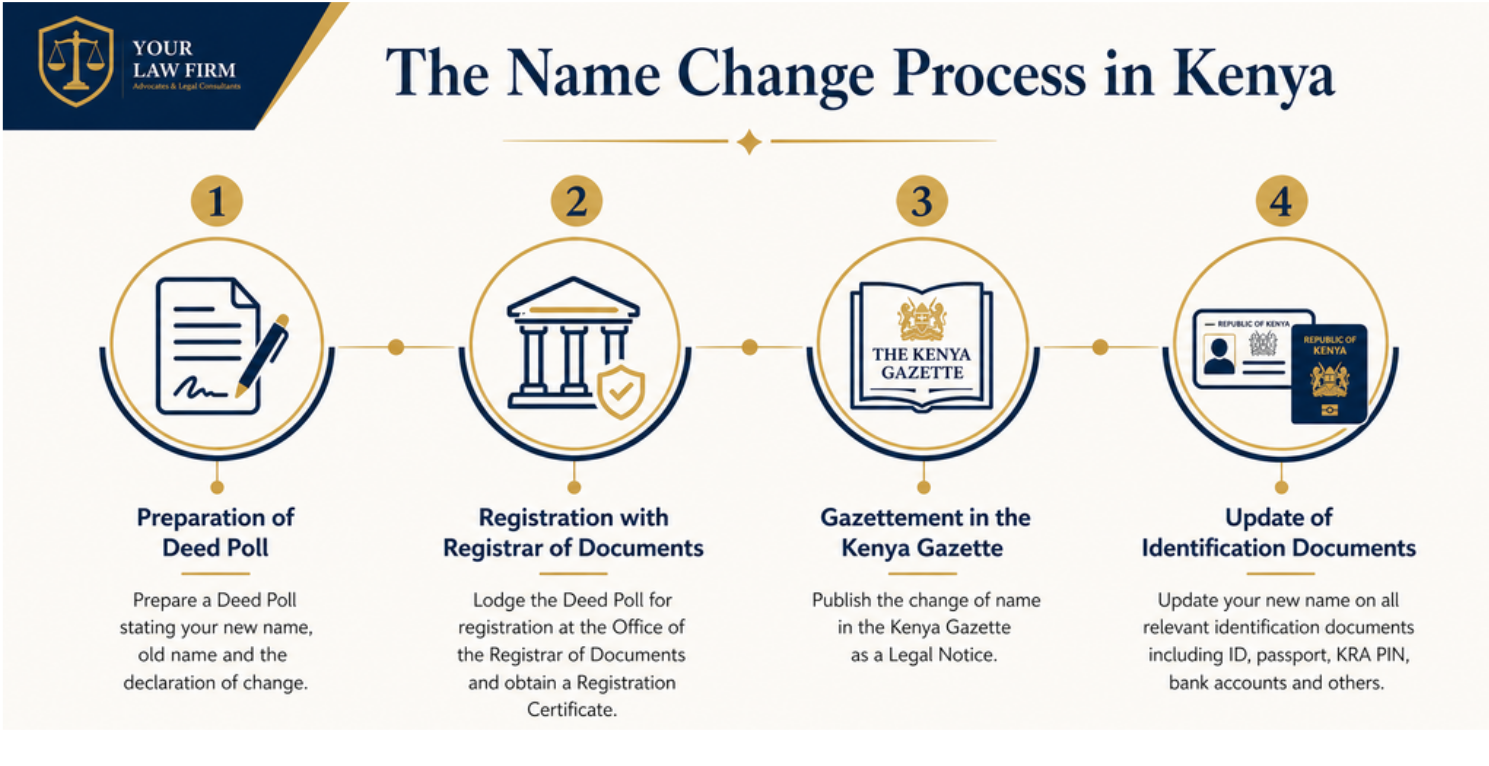
1. Preparation of a Deed Poll

The primary legal instrument for effecting a name change is the Deed Poll. This is essentially a formal legal document executed by an individual declaring that they abandon their former name, adopt a new name, and undertake to use the new name in all legal dealings. The first step is to have an advocate prepare the Deed Poll which must be signed by the applicant and witnessed by a Commissioner for Oaths. The Deed Poll must be accompanied by the following documents:

  • A statutory declaration sworn by a person resident in Kenya who has known the applicant for a significant period of time.

  • A certified copy of the birth certificate or baptism certificate.

  • A certified copy of the national identity card/passport and KRA Pin Certificate.

  • Three colored passport-size photographs.

  • A letter from the local area chief confirming the applicant’s identity and residence.

  • A fingerprint printout obtained from the Registrar.

2. Registration with the Registrar of Documents

The completed Deed Poll, along with all supporting documents, is then submitted to the Registrar of Documents for registration. After payment of the fees, the Registrar will review the documents and register them if satisfied that the applicant has duly complied with all the requirements.

3. Gazettement

Upon registration with the Registrar of Documents, the Advocate shall proceed to prepare a gazette notice and forward to the Government Printer for publication in the Kenya Gazette for a period of 60 days. The name change is legally recognized at this point. Gazettement serves as official public notice to everyone of the change of name and legitimizes the new identity for legal purposes.

4. Update of Identification Documents

After gazettement, the applicant must apply for replacement of their national identity card and thereafter update other documents such as the passport, professional or academic certificates, bank records, land records, among others.

As already noted, additional requirements apply depending on the personal circumstances of an applicant including whether the applicant is a minor, a married woman seeking to adopt her husband’s surname, a divorcee wishing to revert to her maiden name, or a widow.

a) Change of Name for Minors

  • Minors Below 2 Years: For children under two years of age, Section 14 of the Births and Deaths Registration Act provides a simplified procedure. Parents may apply directly to the Registrar of Births and Deaths to alter the child’s name upon payment of the prescribed fees. The application is made by filling out a form at the Registrar and does not require a Deed Poll.

  • Minors Below 16 Years: The law draws a distinction between minors below 16 years and those aged 16 to 18 years for purposes of name change. For a minor under the age of 16, the Deed Poll will be signed by the child’s parent or legal guardian. Where it is signed by one parent, the consent of the other must be provided. The additional documentation are the birth certificate, parents’ identity cards and passport-size photographs and Guardian appointment documents where applicable.

  • Minors Above 16 Years: A person who has attained sixteen years but has not attained eighteen years remains a minor under Kenyan law. However, the law recognises the growing autonomy of this category of minors and seeks to protect them from unilateral changes of names by parents against their wishes. Accordingly, the parent or guardian will execute the Deed Poll but the minor’s consent must be endorsed on the Deed Poll and witnessed by an advocate.

b) Change of Name Following Marriage or Divorce

For a married woman who wishes to adopt her husband’s surname, she will be required to execute the Deed Poll and in addition, obtain the written consent of her husband, endorsed on the Deed Poll and witnessed by an advocate. If living separately from her husband in circumstances where the separation is likely to be permanent, a certificate from an advocate to that effect will be required in place of the husband’s consent. Additional documentation includes the marriage certificate and copies of her husband’s identity card.

c) Change of Name Following Divorce or Widowhood

A divorcee wishing to revert to her maiden name or adopt a new name must provide her certificate of marriage or other evidence of her marriage if it was not registered, together with the decree absolute or certificate of divorce. A widow seeking to change her name must, in addition to the documents in the preceding part, provide her certificate of marriage or other evidence of her marriage if it was not registered and the death certificate of her husband. The widow is described in the document as a widow for purposes of the name change.

Limitations on Change of Name

Although the law recognizes an individual’s right to change their name, that right is subject to certain limitations. The Registrar may decline to register a Deed Poll where the proposed name is vulgar, offensive, blasphemous, impossible to pronounce, or contains numbers, symbols, or punctuation marks. Registration may also be refused where the proposed name promotes criminal activity, hate speech, racial or religious hatred, or the use of controlled drugs; falsely implies the possession of titles such as “Doctor” or “Professor”; or is likely to ridicule individuals, groups, government departments, or organizations. These safeguards are intended to ensure that the process of changing one’s name is not abused for fraudulent, deceptive, or improper purposes.

How ESK Advocates LLP Can Help

At ESK Advocates LLP, we provide comprehensive legal assistance to individuals seeking to change their names under Kenyan law. Whether the application involves a minor, an adult, a married person, or a divorcee, our team offers expert guidance throughout the entire process, including advising on the applicable legal requirements, preparing and registering Deed Polls, facilitating publication in the Kenya Gazette, and assisting clients in updating their official records with the relevant government agencies and institutions. Our commitment is to ensure that every name change application is handled efficiently, accurately, and in full compliance with the law, providing our clients with a seamless and hassle-free experience.

Article By:

Frankline Ojanji

Associate Advocate

Disclaimer: This publication is for informational purposes only and does not constitute legal advice. For tailored legal support, kindly consult our team.

CONTACT US

0714 548 682 | 0717 991 970

info@eskadvocates.co.ke

eskadvocatesllp.co.ke

TRV Centre, Parklands

@eskadvocatesllp