
Introduction
One of the most common misconceptions about the legal system in Kenya is that any person who has suffered a legal wrong can simply file a lawsuit in their own name. Although Article 48 of the Constitution of Kenya guarantees every person the right to access justice, the law also requires that a person must have legal capacity to institute or defend court proceedings. So, what is legal capacity?
Legal capacity refers to the legal ability to institute, defend or participate in litigation. Certain categories of persons either lack this capacity or cannot exercise it independently. In such cases, the law requires another person to act on their behalf.
The three main categories are:
-
Minors (children under the age of eighteen years);
-
Persons with mental incapacity; and
-
Deceased persons.
What Does the Law Say About Legal Capacity?
Although the Constitution guarantees access to justice under Article 48, court proceedings must still comply with procedures set in law.
The Civil Procedure Act and the Civil Procedure Rules, 2010 prescribe who may sue and in what capacity. Where a party lacks legal capacity, the law permits proceedings to be instituted through a legally recognised representative. This approach protects vulnerable persons while ensuring that litigation is conducted fairly.
1. Minor/Child
Under Section 2 of the Children Act, 2022, a child is any person below the age of eighteen years. Although children enjoy constitutional rights under Article 53 of the Constitution, they generally lack the legal capacity to institute or defend court proceedings on their own.
Who Files the Suit on Behalf of a Minor?

Under Order 32 of the Civil Procedure Rules, every suit by a minor must be instituted through a next friend:
-
A parent;
-
A legal guardian;
-
A close relative; or
-
Another suitable adult approved by the court.
On the other hand, where a minor is sued, the court appoints a guardian ad litem to defend the proceedings on the child’s behalf. The next friend or guardian ad litem acts only in the child’s best interests.
This requirement is more than a mere formality and Order 32 Rule 2 allows a defendant to apply for the dismissal of a suit instituted by or on behalf of a minor without a next friend.
In Gladwell Otieno (suing on her own behalf and as the Administrator of the estate of the Late Wambui Otieno (Deceased) & another & 2 others v Standard Group Limited & another [2020] KEHC 6189 (KLR), the court emphasized that failure to comply with the procedural requirements is not merely a technicality that can be cured by Article 159, but it goes right into the validity of the suit.
In contrast, more recently, in Gitiche v Mwendwa & Another (Civil Appeal 358 of 2023) [2026] KEHC 92 (KLR), the High Court considered a case where the plaintiff was 17 years and 11 months old when the suit was filed. Although she attained the age of 18 while the proceedings were pending, the court recognised that, at the time the suit was instituted, she was still a minor and Order 32 Rule 1 therefore applied but that was just an irregularity, not a nullity. It was cured by the 1st Respondent attaining the age of majority shortly after filing and prosecuting the case as an adult.
2. Persons with Mental Incapacity
The law also provides protection for persons who are unable to protect their own interests in court proceedings because of mental incapacity/infirmity. However, it is important to clarify that having a mental illness, dementia or another mental health condition does not automatically mean that a person lacks legal capacity to sue. The relevant question is whether the person’s condition makes them incapable of protecting their interests in the proceedings.
THERES_IMG_HERE
This is provided for under Order 32 Rule 15 of the Civil Procedure Rules, 2010, which extends the procedures applicable to minors to persons who have been adjudged to be of unsound mind and to persons who, although not formally adjudged to be of unsound mind, are found by the court upon inquiry to be incapable of protecting their interests because of mental infirmity.
The requirement for the court to make an inquiry is particularly important. A person cannot simply be treated as legally incapable because a relative alleges that they are mentally ill or because medical evidence indicates that they suffer from a particular condition.
What does the court consider when mental incapacity is alleged?
In Kenya, courts have emphasised that medical diagnosis and legal incapacity are not necessarily the same thing.
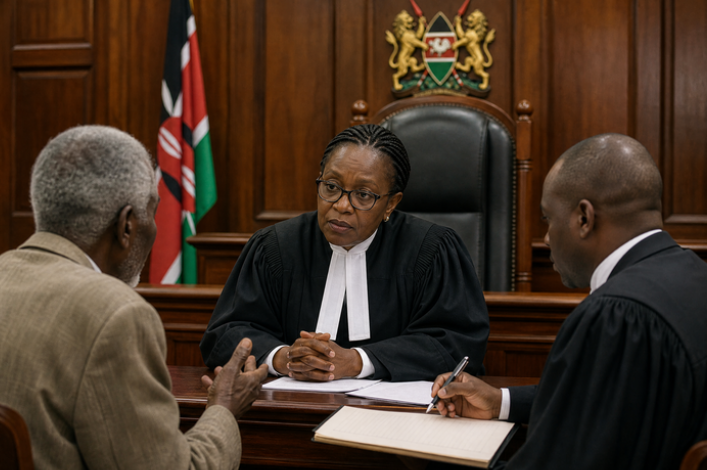
In MMM v AMK, Miscellaneous Civil Application No. 51 of 2015, [2016] KEHC 4741 (KLR), the High Court considered an application concerning an elderly man whose son alleged that he suffered from old age, ill health and senile dementia and was consequently unable to manage his affairs and protect his interests.
The application was supported by medical evidence indicating that the man’s condition affected his ability to manage his property, medical and legal affairs. However, the court had not yet conducted the judicial inquiry contemplated by Order 32 Rule 15.
The High Court held that the medical evidence, although important, could not by itself substitute the judicial inquiry required by the Rules. The court was required to independently determine whether the person was actually incapable of protecting his interests. The court therefore directed that the elderly man be brought before it for the necessary inquiry before any declaration of incapacity or appointment of a guardian could be made.
This decision is important because it establishes two safeguards:
-
First, a medical condition does not automatically amount to legal incapacity.
-
Second, a court must conduct the required inquiry and make its own determination before declaring a person incapable of protecting their interests.
Who can act on behalf of a person who lacks capacity?
Where the court determines that a person is incapable of protecting their interests because of mental infirmity, the procedures under Order 32 Rule 15 of the Civil Procedure Rules may apply. Depending on the circumstances, the court may require a suitable person to act on the individual’s behalf in the proceedings.
The Mental Health Act, Cap. 248 may also become relevant, particularly where the matter concerns the management of the person’s property or affairs. Section 26 of the Mental Health Act provides for orders concerning the management of the estate and, in appropriate circumstances, guardianship of a person suffering from mental disorder.
It is therefore important to distinguish the different legal issues that may arise. A person may require:
-
Representation in litigation under Order 32 Rule 15;
-
Management of property or affairs under the Mental Health Act; or
-
Other protective measures depending on the circumstances.
The precise procedure will depend on the nature of the proceedings and the orders being sought.
3. A Deceased Person Cannot Sue or Be Sued
Death brings legal personality to an end. Once a person dies, they cease to exist as a legal person capable of owning rights in their own name. However, this does not mean that claims automatically disappear. Instead, those rights and liabilities vest in the deceased’s estate, which can only act through a legally recognised personal representative.
Under the Law of Succession Act (Cap. 160), proceedings relating to a deceased person’s estate may only be brought by:
-
An executor appointed under a valid will; or
-
An administrator appointed by the court through a Grant of Letters of Administration.

Such a person is known as the personal representative of the deceased. Without obtaining the appropriate grant, a family member lacks the legal standing to sue on behalf of the deceased.
What Happens if a Suit is Filed Incorrectly?
Failure to comply with the rules can have adverse consequences and depending on the circumstances, the court may strike out the suit, require the appointment of the proper representative or allow an amendment where the defect is minimal or curable.
These requirements are not meant to deny access to justice. Instead, they protect vulnerable persons and promote the proper and efficient dispensation of justice.
Conclusion
The right to seek justice is fundamental, but it must be exercised in accordance with the law. Under Kenyan law, minors, persons who lack mental capacity and deceased persons cannot ordinarily sue or defend proceedings in their own names. Instead, the law requires recognised representatives such as next friends, guardians, or personal representatives to act on their behalf.
Therefore, obtaining legal advice before commencing proceedings can help avoid costly delays and procedural challenges. At ESK Advocates LLP, our litigation team provides strategic legal advice on a wide range of disputes. We will guide you through every stage of the process and ensure your claim is properly instituted and prosecuted.
If you are unsure whether you have the legal capacity to sue, our advocates are ready to help. Contact us today to schedule a consultation for legal advice.
Article By:
Charles Chahilu
Associate Advocate
Disclaimer: This publication is for informational purposes only and does not constitute legal advice. For tailored legal support, kindly consult our team.
CONTACT US
0714 548 682 | 0712 629 335
info@eskadvocates.co.ke
eskadvocatesllp.co.ke
Occidental Plaza, Westlands
@eskadvocatesllp