
THE ESK LEGAL BRIEF
SPOTCHECK ON THE LAW OF SUCCESSION: OVERLOOKED AND UNDERUTILISED PROVISIONS IN KENYA
Introduction
When people think about succession in Kenya, the conversation usually revolves around obtaining a grant, confirming it and distributing the deceased’s property. All these are, of course, the central parts of succession proceedings, but far beyond these, the Law of Succession Act, Cap. 160 contains several other provisions that are often a times overlooked, yet they are equally as important.
This article highlights some of these provisions and why they matter in practice.
1. Reasonable Provision for Dependants (Sections 26-29)
Not every person who depends on a deceased person will necessarily receive what they consider to be a fair share of the estate.
This is why Sections 26-29 of the Law of Succession Act provide a remedy where the deceased’s will or the rules governing intestacy have not made reasonable provision for a dependant. The court has discretion to make appropriate orders, including awarding a specific share of the estate or providing for periodic payments.
This is particularly important because succession is not always simply a question of applying a mathematical formula. The circumstances of the dependants also matter.
In Okello v Onyango [2023] eKLR, the High Court discussed the distinction between persons who qualify as dependants by virtue of their relationship with the deceased and those who must demonstrate actual dependency. In this case, the court defined who a dependant is, and whether they are entitled to reasonable provision. The court held as follows.
“The categories of dependants in section 29 are 2. The first category is of the spouses and children of the deceased. These do not have to prove dependency, that is that they were dependent on the deceased. The appellant was not a spouse nor child of the deceased, so he did not fit within this category. The second category is of those who have to prove dependency. It comprises largely of individuals who were not immediate survivors, that is individuals who do not fall within the circle of spouses and children. Those in the second category are parents, stepparents, grandparents, grandchildren, stepchildren, children whom the deceased had taken into the family as his own, siblings, halfsiblings and the husband of the deceased, if the deceased was a woman. Going by the second category, it would appear that the appellant herein qualified to bring an application, being a brother or sibling of the deceased.
19.Being a brother is one thing, being dependent on the deceased is another. A brother of the deceased would qualify to bring an application, under section 26, as a dependant, upon proof that he was dependent on the deceased during his lifetime. Dependency is gauged along the lines of depending on the deceased for his wellbeing. The best test would be whether he was dependent in the same mode as an immediate family member, a wife or child of the deceased. Did he depend on him for food, shelter, clothing, medical care, educational or schooling needs, among others? If the alleged dependency was within that mode, then he would fit the definition of a dependant.”
The upshot of this is that where a person believes that they have been inadequately provided for, Sections 26-29 may provide an additional avenue for relief.
2. Previous Gifts May Affect the Final Distribution (Section 42)
It is not uncommon for parents to give property to some of their children during their lifetime. The question is what happens when the parent eventually dies and the remaining estate is being distributed.

Section 42 requires certain previous benefits given to children, grandchildren or spouses should be taken into account when determining their shares of the estate.
The Court of Appeal considered this issue in Patrick Munene Migwi v Simon Nyamu Migwi [2017] eKLR, emphasizing the importance of accounting for property previously given to beneficiaries. The facts of this case were fairly straightforward.
The deceased died on 1st August 2005 leaving behind two children, the Respondent and Margaret Wanjiku Migwi (Margaret).
Unfortunately, Margaret died on 29th January, 2012 leaving behind two children surviving her, the appellant and his sister, Purity Wawira Wanjiku. It was also not in dispute that the deceased gave the Respondent 3 acres of land as a gift inter vivos during his lifetime. It was further not disputed that the Respondent sold the 3 acres to one Peterson Kinyua as the Respondent conceded as much. The deceased had 6 acres of land and having already gifted the Respondent 3 acres, the Court held that Margaret was entitled to the remaining 3 acres.
The practical significance is straightforward: two beneficiaries may not necessarily be entitled to identical portions of the remaining estate if one has already received a substantial benefit from the deceased.
3. Grandchildren and the Principle of Representation (Section 41)
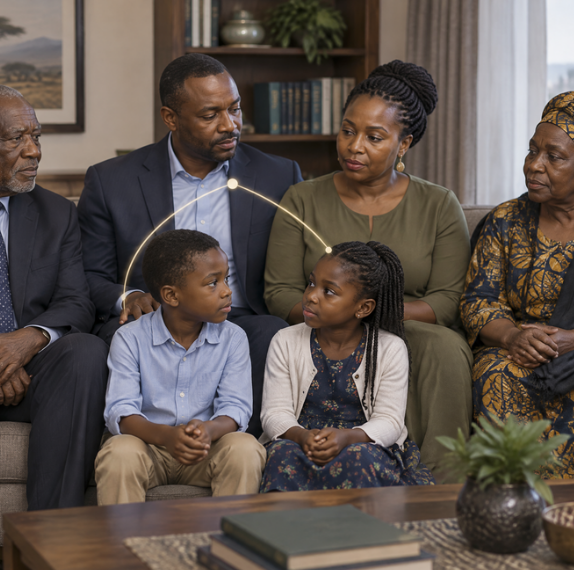
The fact that a person is a grandchild of the deceased does not, by itself, determine whether they inherit directly from the estate.
Section 41 provides for the principle of representation. Where a child of the deceased has died before the deceased, that child’s children may step into their parent’s place and take the share their parent would have received. For example, if John (deceased) had three children (Peter, James and Paul), but one child (Peter) died before John, leaving children of his own, those grandchildren may inherit the share that would have gone to Peter.
The High Court reaffirmed this principle in In re Estate of Habel Karobia Thumi (Deceased) [2025] eKLR.
Practical takeaway: When preparing a succession application, it is important to look beyond the surviving children and establish whether any deceased child left descendants.
4. Intermeddling (Section 45)
Family disputes sometimes begin immediately after death, particularly where one person takes control of the deceased’s property. This is what is referred to as intermeddling.
Section 45 prohibits intermeddling with the free property of a deceased person without lawful authority. Intermeddling is not limited to selling land. It may include unlawfully taking possession of, disposing of, collecting or otherwise dealing with estate property.

In In re Estate of Augustine Muita Kahare (Deceased) [2019] eKLR, the court considered the handling of estate money without authority in the context of Section 45. In this case, an objector had received the sum of Kshs. 2,975,000/= on behalf of the estate of the deceased from the sale of a piece of land. She is said to have received the money on behalf of her children who were entitled to the estate of the deceased. Although she was not the one who disposed of the property, the fact that she had received the money meant that she was an intermeddler who ought to account to the legitimate personal representative of the deceased.
The provision is important because it protects an estate during the period between death and proper administration. It is an important reminder that a family member does not acquire the right to deal with estate property simply because they are a spouse, child or other relative of the deceased.
5. A Grant Does Not Make an Administrator the Owner (Sections 79, 82 and 83)
Another common misconception is that once someone obtains a grant of representation, the estate property effectively becomes theirs. That is not the position. The fact that the property may be registered in the name of the administrators does not make it their property.
Section 79 vests the deceased’s property in the personal representative, but the administrator holds and manages that property for purposes of administering the estate and for the benefit of those entitled to it.
The administrator’s powers are set out under Section 82, while Section 83 imposes important duties, including collecting the assets of the estate, paying debts and expenses, accounting for the estate and completing the administration.
In In Re Estate of Christom Kinyua Wainaina (Deceased) [2014] eKLR, the High Court emphasised the fiduciary nature of the administrator’s position and held as follows;
“Be that as it may, Section 79 of the Law of Succession Act vests the property of the deceased in the personal representatives, that is to say the executors named in the will of the deceased or the administrators of the estate appointed by the court. It is the personal representatives who should hold legal title to the property. They can sue or be sued over the said property, and can enter into and enforce contracts over the property on behalf of the estate. They therefore exercise the powers of the owner over the estate, and are subject to the same duties over the property as the deceased would have been subject to.”
6. Confirmation of Grant is More Than a Formality (Section 71)
Confirmation of a grant is sometimes treated as the final administrative step in a succession matter. However, it is much more important than that.

Under Section 71, the court must satisfy itself as to the persons beneficially entitled to the estate and their respective shares before confirming the grant. This means that the confirmation stage is an opportunity to identify omissions, resolve questions concerning beneficiaries and ensure that the proposed distribution is lawful. It is mandatory that all relevant parties must be present.
In Gerald Ambosa Liona & 4 Others v Ernest Shipoche Liona [2020] eKLR, the High Court emphasised the importance of the confirmation process in succession proceedings. It held as follows:
“20. Confirmation of grant is the most critical stage in the life of a succession cause. It sets in motion the process of the distribution of the estate, which is the reason the succession cause is filed in the first place. After confirmation, the cause comes to a close. Since distribution is the reason for the filing of the succession cause, it is important that the same be handled with care, for whenever the confirmation proceedings are bungled the parties do not get closure.”
Therefore, a confirmation application should be prepared carefully. It should reflect the actual family structure, all relevant beneficiaries and the proposed distribution of the estate.
7. Revocation of Grant Has Several Grounds (Section 76)
When people hear about revocation of a grant, they often immediately think of fraud. Fraud is certainly one ground, but it is not the only one.
Section 76 also allows a grant to be revoked where, among other things:
• the proceedings were defective;
• material information was concealed;
• an administrator fails to diligently administer the estate;
• required accounts or inventories are not produced; or
• the grant has become useless or inoperative
A beneficiary who is concerned about the conduct of an administrator should consider the specific grounds under Section 76 rather than simply alleging that the grant was “irregular.”
8. Limited Grants (Section 54)
Not every succession problem requires waiting for a full grant. Section 54 allows the court to issue limited grants for particular purposes. For example, a grant ad colligenda bona may be appropriate where estate property requires urgent collection or preservation, while a grant ad litem may be used where representation of an estate is required in legal proceedings.
These limited grants are particularly useful where immediate action is required, but the circumstances do not yet justify, or permit, the issuance of a full grant.
Conclusion
Succession practice is not simply about obtaining a grant and dividing property. The Law of Succession Act provides a range of safeguards and remedies designed to protect estates and the people who are entitled to benefit from them.
In summary, and before filing or responding to a succession application, it is useful to ask:
• Are all dependants accounted for? Sections 26-29.
• Did any beneficiary receive property during the deceased’s lifetime? Section 42.
• Did any child of the deceased predecease them? Section 41.
• Is anyone dealing with estate property without authority? Section 45.
• Has the administrator properly performed their duties as required by law? Sections 82-83.
• Have all beneficiaries and their shares been identified? Section 71.
• Are there grounds for revoking an existing grant? Section 76.
• Does the estate require urgent action through a limited grant? Section 54.
Need Assistance With a Succession Matter?
Succession disputes can become complicated quickly, especially where there are competing beneficiaries, disputed assets, questions of dependency, or concerns about the conduct of an administrator.
At ESK Advocates LLP, we advise and represent clients on a wide range of succession matters. If you are dealing with a succession matter and are unsure of your rights or the appropriate legal steps to take, our team can help you understand your position and guide you through the process. Contact us for professional legal advice and representation on succession matters.
Article By:
Charles Chahilu
Associate Advocate
Disclaimer:
This publication is for informational purposes only and does not constitute legal advice. For tailored legal support, kindly consult our team.
CONTACT US
0714 548 682 | 0712 629 335
Occidental Plaza, Westlands