
Introduction
Adoption is a concept that most people in Kenya are familiar with in its broad sense, but there is more to it. It is both a legal and social process through which a child is permanently integrated into a new family, whereby the new adoptive parents assume full responsibility of the adopted child. In Kenya, most people understand it from a social perspective, but with the new dispensation of the Children Act 2022, read in line with the Constitution of Kenya 2010, it is highly regulated and anchored on one central principle: the best interest of the child. The adoption process in Kenya is intricate and highly regulated, rightly so, given past unpleasant experiences that many adopted children have suffered in the hands of people who did not mean well for them. As such, it is important to understand the intricate processes, requirements, eligibility, and stages if you are a prospective adoptive parent. This article outlines the key stages, legal considerations as well as practical realities of adoption in Kenya.


The Legal Foundation and Types of Adoption
Introduction The legal framework governing adoption in Kenya is primarily found in the Children Act, 2022, which recognizes different forms of adoption depending on the relationship between the adopter and the child. These include local adoption, international adoption, and kinship adoption.
Local adoption typically involves Kenyan citizens adopting a Kenyan child within the country, while international adoption applies where non-Kenyan applicants seek to adopt a Kenyan child. Kinship adoption, on the other hand, arises where the adopter is a relative of the child, such as a grandparent, sibling, or step-parent. Although the broad process remains similar across these categories, certain procedural requirements, particularly in international adoptions, may be more stringent.
Who Qualifies: Eligibility of the Child and the Adopter
Before any adoption process can commence, the law requires that both the child and the prospective adopter meet specific eligibility criteria.
A child must be at least six weeks old and must have been formally declared free for adoption by a registered adoption society. This declaration is important because it confirms that the child is legally available for adoption. In cases involving children who have been abandoned, there are additional requirements needed; for example, a police report is necessary to ensure that all reasonable efforts have been made to trace the biological parents.
On the other hand, a prospective adopter must meet certain statutory thresholds relating to age, capacity, and suitability. The adopter must be at least twenty-five years old and at least twenty-one years older than the child, but not above sixty-five years. They must also be of sound mind, financially capable, and of good moral standing. Where two applicants apply jointly, the law requires that they be married to each other.
The law further places restrictions on certain categories of applicants, such as sole applicants seeking to adopt a child of the opposite sex, unless special circumstances exist.

The Role of Adoption Societies
One of the most distinguishing features of the adoption process in Kenya is the central role played by a registered adoption society. Prospective adoptive parents cannot initiate the process themselves. Instead, they must work through accredited institutions in Kenya that have been registered as an Adoption Society. There are not many in Kenya, and examples of such societies include Little Angels Network, Kenyans to Kenyans Peace Initiative (KKPI) Adoption Society, Kenya Christian Homes, and Child Welfare Society of Kenya.
These societies may be viewed as gatekeepers of the process. They are responsible for assessing the suitability of applicants, declaring children free for adoption, facilitating placement, and supervising the fostering period. Their role ensures that both the child and the prospective parents are adequately prepared for adoption.
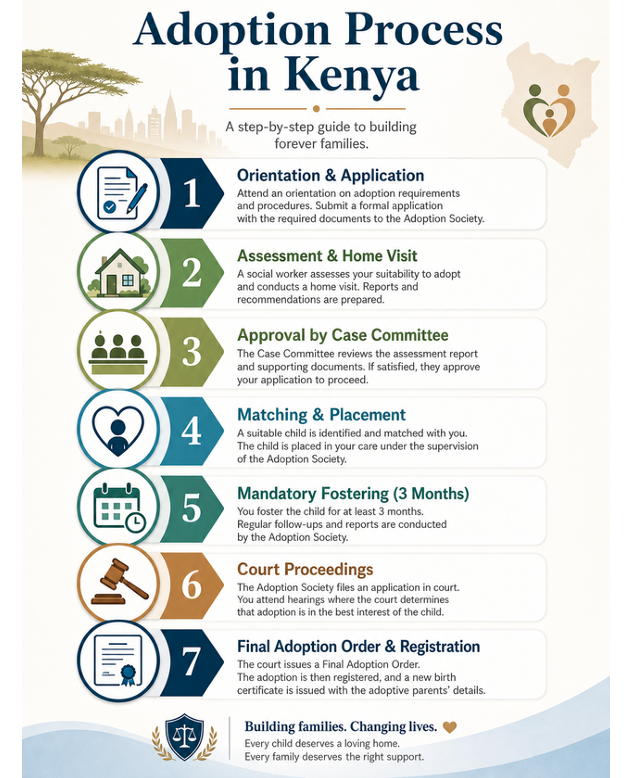
The process typically begins with an orientation meeting, during which applicants are taken through the legal requirements, documentation, timelines, and financial implications. This stage is crucial in setting expectations and ensuring that applicants understand the commitment involved.
Assessment, Matching and Placement
Following the submission of an application, the adoption society undertakes a comprehensive assessment of the prospective adopter. This includes a home visit conducted by a social worker, who evaluates the living conditions, financial stability, and overall suitability of the home environment. The assessment also involves in-depth interviews aimed at understanding the applicant’s motivation and readiness to adopt. Once the assessment is complete, a report is prepared and presented to the society’s case committee for determination. If the application is approved, the next stage involves matching the adopter with a child. This is not a selection process driven by the adopter, but rather a structured matching exercise guided by the best interests of the child. After a successful introduction and initial bonding, the child is placed with the adoptive parents.
The Fostering Period
The law requires a mandatory fostering period of at least three months before an adoption application can be presented in court. During this time, the child stays with the adoptive parents to allow both parties to connect and bond. This period is closely monitored by social workers, who conduct regular visits and prepare reports on the child’s welfare and adjustment.
The Court Process
Adoption proceedings are handled before the High Court of Kenya, which has the jurisdiction to grant adoption orders. The court process is initiated by filing an Originating Summons supported by various documents, including reports from the adoption society and the Directorate of Children Services.
At this stage, the court may appoint a guardian ad litem whose role is to represent the interests of the child during the proceedings. The guardian conducts independent inquiries and submits a report to assist the court in making its determination. Before granting an adoption order, the court must be satisfied on several key issues, including: That all necessary consents have been obtained That the applicant is fit to adopt That the adoption is in the best interests of the child Only upon satisfying these conditions will the court issue an adoption order
Legal Effect of an Adoption Order
An adoption order has huge legal consequences. It permanently extinguishes the parental rights of the biological parents and vests those rights in the adoptive parents. In effect, the child is treated as if they were born to the adoptive family, with full rights of inheritance and parental care. It is for this reason that the adoption process is quite intricate and highly regulated.
Post-Adoption Formalities
When the court issues an adoption order, that is not the end of it. The process now moves to the administrative stage so as to formalize the process and acquire all necessary documentation for the Child. Once issued, the order must be registered with the Office of the Registrar General, which enters the adoption in the Adopted Children Register and issues an adoption certificate. Afterwards, a new birth certificate is issued, indicating the adoptive parents as the child’s legal parents. These steps necessary to reflect the child’s new legal identity with the new family.

Post-Adoption Monitoring
Even after the legal process is complete, adoption agencies may continue to play a supportive role. Post-placement assessments are conducted to monitor the child’s adjustment and well-being within the new family environment. In some cases, periodic reports may be required, particularly in international adoptions. This ongoing support reflects the understanding that adoption is not merely a legal event, but a long-term process that requires emotional and social adjustment.
Conclusion
The adoption process in Kenya is deliberately rigorous to protect children and ensure that only suitable applicants are entrusted with parental responsibility. From initial assessment to court approval and postadoption support, each stage is designed to uphold the best interests of the child. At ESK Advocates LLP, we guide clients through every stage of the adoption process, from initial eligibility assessments and engagement with adoption societies to court representation and post-adoption compliance.
Article By:
Charles Chahilu
Associate Advocate