Screenshot from 2026-06-25 22-47-41

THE ARTIFICIAL INTELLIGENCE BILL , 2026

Overview

Kenya’s Senate has introduced the Artificial Intelligence Bill, 2026, the country’s first dedicated legal framework for the regulation and governance of AI. The Bill establishes a new regulator, sets rules for how AI systems may be developed and deployed, and creates criminal offences for non-compliance. Once enacted, it will affect any business or individual that develops, deploys, or uses an AI system in Kenya.

2.The New Regulator

This article explores the opportunity, the regulatory framework, and the legal considerations surrounding REITs in Kenya and why forward-thinking investors and developers should start paying attention.

3.What This Means for Your Business

i. Risk Classification

All AI systems will be classified into one of four risk tiers, which determines the level of compliance required:

• Unacceptable Risk — banned outright with no exceptions.

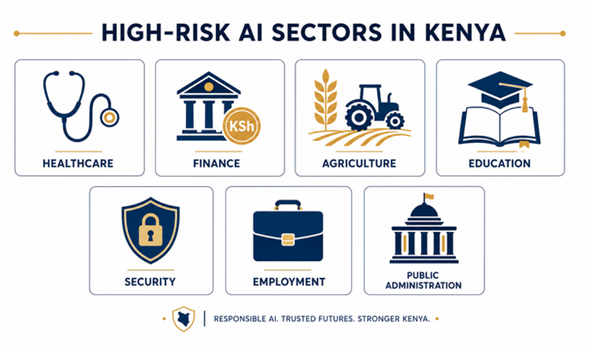
• High Risk — AI used in healthcare, finance, agriculture, education, security, employment, or public administration. Subject to the most demanding obligations.

• Limited Risk — moderate-risk systems, primarily subject to transparency and disclosure requirements.

• Minimal Risk — low-risk systems with minimal compliance obligations.

If You Deploy a High-Risk AI System
Businesses operating in high-risk sectors will be required to:

• Conduct a risk assessment and a human rights impact assessment before deploying the system.

• Ensure the system is transparent and explainable, so that users understand how decisions are made.

• Keep records of data inputs, training datasets, outputs, and performance metrics for at least five years.

• Obtain explicit consent and clearly label AI-generated content where the system produces or manipulates images, voice, or likeness.

• Submit annual compliance reports to the AI Commissioner.


ii. Workforce Obligations

Any business introducing an AI system likely to displace workers must conduct a workforce impact assessment and implement reskilling programs in collaboration with government agencies. This applies to any employer automating functions that affect existing roles. ESK ADVOCATES LLP APRIL 2026 eskadvocatesllp.co.ke 4.Key Takeaways The AI Bill 2026 signals a significant regulatory shift for any organization developing, deploying, or using AI systems in Kenya.

iii. Penalties

Clients should note the following: Non-compliance carries serious consequences. Major violations such as deploying a prohibited or high-risk AI system without the required assessments shall attract a fine of up to Kshs. 5,000,000 and/or two years’ imprisonment. Transparency and disclosure failures attract a fine of up to Kshs. 1,000,000 and/or six months’ imprisonment. Directors and officers can be held personally liable where they had knowledge of an offence and failed to act.

4.Key Takeaways

The AI Bill 2026 signals a significant regulatory shift for any organization developing, deploying, or using AI systems in Kenya. Clients should note the following:

• Organizations should begin auditing their existing AI systems against the Bill’s risk classification tiers now, ahead of the Act’s commencement.

• Businesses operating in healthcare, finance, education, agriculture, security, employment, or public administration should expect the most intensive obligations including pre-deployment impact assessments, record-keeping for five years, and annual compliance reporting.

• Any AI product that generates or manipulates images, voice, or likeness will be subject to strict consent and labelling requirements with criminal sanctions for non-compliance.

• All county and national government bodies using AI must comply with the Act in full. Non-compliant public sector AI use is a criminal offence.

• Employers introducing AI that may displace workers must conduct impact assessments and implement reskilling programs in partnership with government agencies.

• The sandbox mechanism offers an avenue for businesses to test innovative AI solutions in a supervised environment clients in the innovation and technology sector should monitor sandbox eligibility criteria once the Commissioner is appointed.

• The Act will be reviewed every three years to keep pace with technological change, meaning compliance obligations may evolve.

5.How ESK Advocates LLP Can Help

The AI Bill introduces a new layer of legal and regulatory obligations that will require careful navigation. ESK Advocates LLP is well positioned to guide your business through this transition in the following ways;

· AI Compliance Audits — reviewing your existing and planned AI systems to determine their risk classification and the compliance obligations that apply to your business.

· Impact Assessments — advising on and preparing the risk assessments and human rights impact assessments required before deploying high-risk AI systems.

· Regulatory Engagement — representing your interests before the Office of the AI Commissioner, including in enforcement proceedings, investigations, and sandbox applications. · Contract and Policy Review — updating your internal AI policies, data processing agreements, and vendor contracts to align with the new law.

· Workforce Advisory — advising employers on workforce impact assessment obligations and the legal framework for reskilling and transition programs.

· Ongoing Compliance Support — providing continued legal support as regulations and guidelines are issued under the Act and as the law evolves through its three-year review cycle.

To discuss how the AI Bill may affect your business, please contact ESK Advocates LLP.


Article By :

Joyce Nduta

Holding-Over Associate


Screenshot from 2026-06-25 22-33-17

THE PAROL EVIDENCE RULE IN COMMERCIAL LITIGATION

A Critical Analysis of Sections 97 and 98 of the Evidence Act in I & M Bank Limited v Buzeki Enterprises Limited (2026)

Abstract

The 2026 decision of the High Court of Kenya in I & M Bank Limited v Buzeki Enterprises Limited delivered on 13th February 2026 represents a significant reaffirmation of the parol evidence rule under Sections 97 and 98 of the Evidence Act (Cap 80). Although arising from enforcement of a promissory note, the judgment offers broader doctrinal clarification on the admissibility of oral evidence in the face of written commercial instruments. This note examines the Court’s interpretation of Sections 97 and 98, its narrowing of the “condition precedent” exception, and the implications of the decision for evidentiary certainty in commercial litigation. It argues that the ruling reflects a deliberate judicial preference for documentary supremacy and commercial predictability over equitable flexibility

Definition of the Parol Evidence Rule

The parol evidence rule is a principle of contract and evidence law which provides that where parties have reduced their agreement into writing, oral statements or other outside evidence are not admissible to contradict, vary, add to, or subtract from the terms of the written document.

The rule rests on the presumption that the written instrument embodies the final and complete expression of the parties’ intentions. Accordingly, once contractual terms are formally recorded, the document itself becomes the exclusive source of proof of those terms, subject only to limited statutory or common law exceptions such as fraud, mistake, or the existence of a collateral agreement. In Kenya, the rule is codified in Sections 97 and 98 of the Evidence Act (Cap 80), which govern the admissibility of oral evidence in relation to written contracts.

The decision of the High Court of Kenya in I & M Bank Limited v Buzeki Enterprises Limited (2026) provides a modern judicial exposition of Sections 97 and 98 of the Evidence Act (Cap 80). While framed as a commercial dispute concerning enforcement of a promissory note, the case is fundamentally lay a straightforward but doctrinally significant question: “Can oral evidence be admitted to vary the express terms of a written negotiable instrument?” The Court answered firmly in the negative. In doing so, it reaffirmed the centrality of the parol evidence rule in Kenyan jurisprudence and clarified the limited scope of its statutory exceptions.

Section 97 and the Statutory Entrenchment of the Parol Evidence Rule The Structure of Section 97

Any business introducing an AI system likely to displace workers must conduct a workforce impact implement reskilling assessment programs collaboration with government agencies. This applies to any employer automating functions that affect existing roles. Section 97(1) of the Evidence Act provides that where the terms of a contract have been reduced into writing, no evidence shall be given in proof of those terms except the document itself or admissible secondary evidence of its contents. Section 97(2) goes further and prohibits the admission of oral evidence to contradict, vary, add to, or subtract from the written terms. This provision codifies the common law parol evidence rule and rests upon three foundational assumptions: 1. A written agreement embodies the final intention of the parties. 2. Documentary evidence is inherently more reliable than oral recollection. 3. Commercial stability depends upon certainty of written obligations. Section 97 therefore serves both evidentiary and policy functions.

Application in the Case

In I & M Bank v Buzeki, the Defendant argued that payment under a promissory note was conditional upon the sale of a parcel of land known as “Taru Ranch.” The written instrument, however, was clear and unequivocal. It specified: · A fixed principal sum; · A fixed maturity date; · An unconditional promise to pay. The Defendant sought to introduce oral testimony to demonstrate that repayment would only crystallize upon sale of the property.

The Court rejected this attempt and held that admitting such evidence would directly contradict the fixed maturity date and transform the nature of the instrument from unconditional to contingent. Under Section 97, the written document was conclusive proof of its terms. The evidentiary inquiry ended with the document itself. The judgment thus affirms that Section 97 is not a mere technical rule of exclusion; it is a structural doctrine safeguarding the integrity of written agreements.

Section 98 and the Limits of Flexibility The Provisos to Section 98

Section 98 introduces exceptions to the rigidity of Section 97. Oral evidence may be admitted to prove: Fraud Mistake Illegality Failure of consideration A separate oral agreement not inconsistent with the written contract A condition precedent These provisos ensure that the parol evidence rule does not operate as an instrument of injustice. However, they are carefully circumscribed.

The Defendant relied, implicitly, on the proviso permitting proof of a condition precedent but the Court drew a crucial doctrinal distinction. A valid condition precedent must operate consistently with the written contract. It cannot negate or contradict its express terms.The alleged oral condition in this case was not collateral or explanatory. It directly displaced the fixed maturity date and sought to introduce an uncertain contingency. The Court concluded that the oral evidence was inconsistent with the written instrument and fell outside the protective scope of Section 98. This interpretation narrows the practical operation of the condition precedent exception and reinforces the primacy of documentary clarity in commercial contexts.

Documentary Supremacy in Commercial Transactions

An important dimension of the decision is its commercial context. The instrument in question was not an informal private agreement; it was a promissory note a negotiable instrument capable assignment and reliance by third parties. Allowing oral conditions to modify such an instrument would introduce uncertainty into commercial finance and undermine negotiability.

The Court’s strict application of Sections 97 and 98 reflects an appreciation of this commercial reality. Evidence law, in this instance, serves a systemic function: Protecting financial predictability; Preserving reliance on written instruments; Preventing opportunistic litigation defences. The decision thus situates Sections 97 and 98 within a broader policy framework of commercial certainty.

Pleadings, Discipline Proof, and Evidentiary

Although primarily an interpretation of Sections 97 and 98, the judgment also reinforces the pleadings relationship and between admissibility.The Defendant’s reliance on an oral condition was not firmly grounded in the pleadings. The Court’s unwillingness to entertain that line of defence underscores a broader evidentiary principle. Issues for determination flow from pleadings, and evidence inconsistent with pleaded terms cannot be introduced to reshape the dispute. This procedural discipline complements the substantive rigidity of Section 97.

Critical Evaluation

APRIL 2026 eskadvocatesllp.co.ke The decision may be viewed as reflecting a formalist approach to contractual interpretation. Critics might argue that strict enforcement of documentary supremacy may sometimes subordinate equitable considerations.
However, in commercial litigation, particularly involving negotiable instruments, predictability often outweighs flexibility. The Court appears to have consciously prioritised systemic stability over case-specific accommodation.
From an evidence law perspective, the ruling clarifies that: · Section 97 establishes a strong presumption of documentary completeness. · Section 98 does not permit contradictions disguised as explanations. · Oral evidence cannot be used to rewrite clear written obligations. The case therefore strengthens doctrinal coherence in Kenyan evidence jurisprudence.

Conclusion

I & M Bank Limited v Buzeki Enterprises Limited stands as a contemporary reaffirmation of the parol evidence rule in Kenya. Daniel Munyoki Article By : Associate Advocate The High Court demonstrated that: Written contracts are conclusively proved by the document itself under Section 97. The exceptions in Section 98 are narrow and cannot be invoked to contradict express terms. In commercial litigation, documentary certainty is paramount. The decision reinforces the evidentiary hierarchy between written and oral proof and signals that courts will guard the integrity of commercial instruments with doctrinal firmness. As Kenyan commercial litigation continues to expand in complexity and volume, this case will likely serve as a leading authority on the operation of Sections 97 and 98 of the Evidence Act.


Article By:

Daniel Munyoki
Associate Advocate


Screenshot from 2026-06-24 08-49-34

THE KOKO NETWORK EXPERIENCE

A TURNING POINT FOR KENYA’S CARBON MARKET

Introduction

KOKO Networks built a bold business model around bioethanol cooking fuel distributed through a nationwide network of smart dispensers. Millions of Kenyan households used its clean-cooking solution as an alternative to charcoal.

However, the company’s financial model relied heavily on generating and selling carbon credits linked to the emissions reductions achieved through cleaner cooking technologies. When regulators declined to authorize the scale of carbon credits the company sought to issue, the model became financially unsustainable, ultimately contributing to the firm’s shutdown. While the circumstances are complex, the broader implications for the Kenya carbon credits sector are significant.

This article highlights three important lessons: i. Carbon credits are now subject to increasing regulatory scrutiny ii. Measurement and verification standards are becoming more stringent Commercial models must align with national climate policy and international carbon market rules For investors and climate innovators, the message is clear: carbon projects must be structured as regulatory projects first and commercial projects second.

Kenya Carbon Credits: A Rapidly Evolving Regulatory Framework

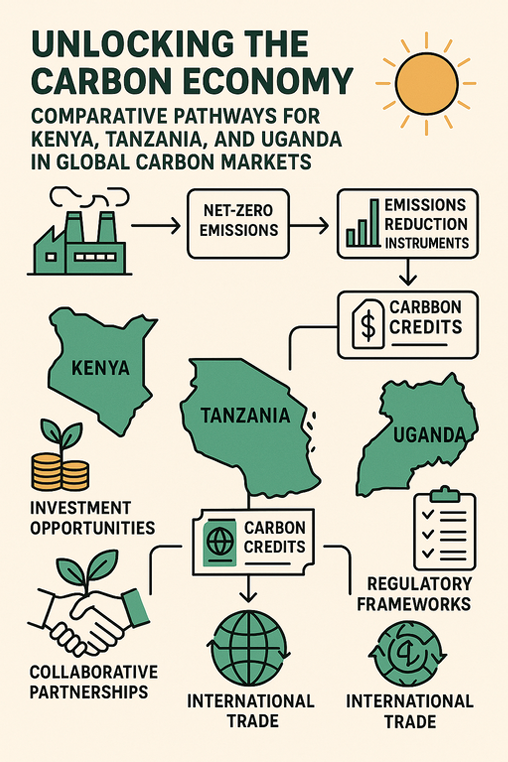
Kenya has taken decisive steps to establish a formal legal framework governing the generation and trading of carbon credits. The Climate Change (Amendment) Act 2023 introduced mechanisms enabling Kenya to participate in international carbon markets under the Paris Agreement. The legislation empowers the government to authorize carbon projects and enter into agreements for emissions reduction trading. Building on this framework, the Climate Change (Carbon Markets) Regulations 2024 now provide operational rules governing carbon project development in Kenya.

Key features of the regulatory framework include: i. National Authorization of Carbon ProjectsAll carbon projects must obtain formal approval before generating tradable carbon credits. ii. Community Benefit-Sharing RequirementsKenya has introduced progressive rules requiring revenue sharing with local communities, particularly for land-based carbon projects. iii. National Carbon Credit Registry- The government is establishing a national registry to track carbon credits and prevent double counting. iv.

Alignment with the Paris Agreement- The framework enables Kenya to participate in international carbon trading mechanisms under Article 6 of the Paris Agreement. v. Primary agencies include the State Department of Environment which shall oversee Climate Directorate and carbon project approvals and the National Environment Management Authority (NEMA) for environmental compliance. The National Treasury may later manage auction revenue if a cap-and-trade scheme is introduced. For international investors, developments significantly enhance the credibility and bankability of Kenya carbon credit projects.
The International Dimension: Lessons from the UK Carbon Market

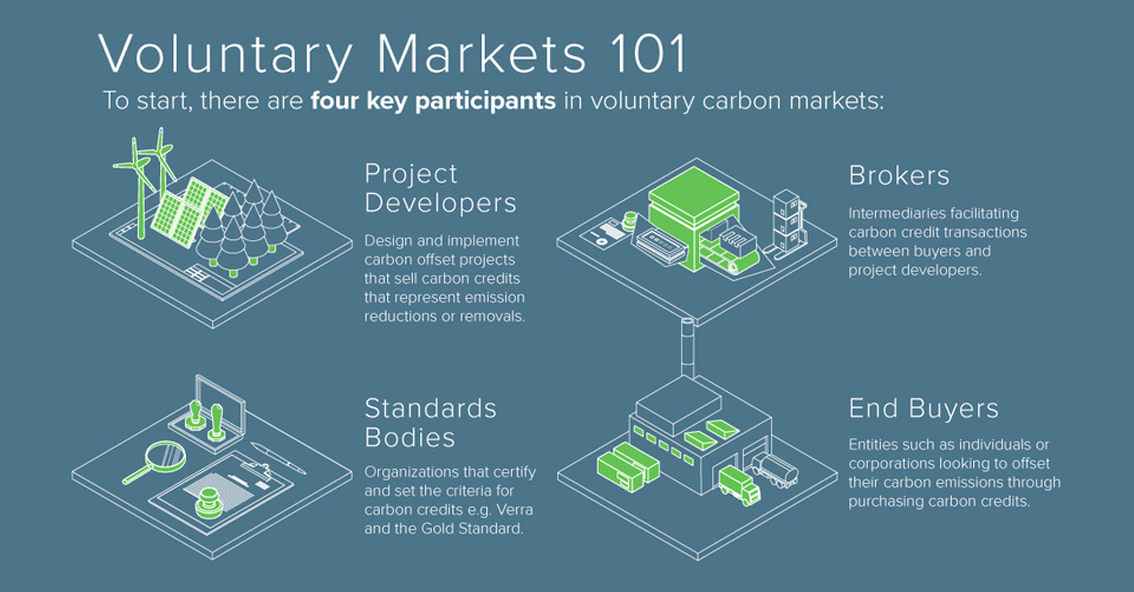
Kenya’s regulatory approach reflects a broader global trend toward more structured carbon markets. A useful comparison can be drawn with the United Kingdom. The UK operates the UK Emissions Trading System (UK ETS) — a cap-and-trade scheme that sets limits on greenhouse gas emissions from major industries and allows companies to trade emissions allowances. The UK Emissions Trading Registry is a secure online application “like a bank account” for allowances.

Operator Holding Accounts (OHAs) and Aircraft Holding Accounts (AOHAs) store allowances and verified emissions data. Trading accounts (unlinked to compliance) allow market trading.The UK also maintains a Kyoto Protocol Registry, now used for international units. This robust digital registry underpins UK ETS integrity.

Beyond the compliance market, the UK government has also introduced Principles for Voluntary Carbon Market Integrity aimed at strengthening the voluntary carbon market, including: i. enhanced verification and integrity standards for carbon credits ii. regulatory oversight to prevent greenwashing transparency rules for carbon credit transactions The UK is positioning itself as a global hub for climate finance and carbon trading.

Importantly, many corporations participating in these markets seek high-quality carbon credits from international projects, particularly in emerging markets. This creates a direct commercial link between Kenya’s carbon projects and international carbon markets. This intersection between domestic carbon regulation and international climate finance is where significant commercial opportunities will emerge.
Comparative Study and Attendant Risks

Key contrasts between the UK and Kenyan systems (and associated risks) include:
i. Registry & Infrastructure:
The UK ETS has a mature digital registry for allowances and units. Kenya’s registry is newly formed and untested. Risk: Credit-tracking may be fragmented or non-transparent infrastructure is built. until digital
ii. Compliance vs Voluntary Markets:
UK compliance (ETS) is well-defined; Kenya currently has no nationwide cap-andtrade, relying on voluntary trades. Risk: Without a compliance market or price floor, Kenyan credits may lack guaranteed demand/pricing, hurting confidence. investor
iii. Monitoring, Reporting & Verification (MRV):
MRV refers to Measurement, Reporting, and Verification, a crucial framework under the United Nation Framework Convention on Climate Change (UNFCCC) used to track greenhouse gas (GHG) emissions, mitigation actions, and climate support and ensures transparency and accuracy in carbon markets and national climate pledges. UK MRV procedures are codified under EU-derived regulations. Kenya must develop its own MRV protocols (likely based on UNFCCC/CDM rules) and capacity for verification. Risk: Weak MRV could undermine credit integrity and investor trust.

i. Permanence/Reversals:
UK allowances (ETS) assume permanent emission reductions. Kenya’s regulations require projects to account for reversals. The UK voluntary principles also insist on buffers/insurance. Risk: Kenya must define how to handle reversals (e.g. forest fires); failure could devalue credits.

ii. Double-Counting / Corresponding Adjustments:
The UK registry cleanly tracks units; UK compliance credits are accounted in national inventories. Kenya faces the CORSIA correspondingadjustment issue – its delay was fatal for KOKO Networks. Risk: If Kenya does not commit to clear adjustment rules, international buyers will avoid Kenyan credits to prevent double-counting.

iii. Revenue Sharing / Social Contributions:
Kenyan law mandates local community benefit-sharing for projects; the UK ETS instead funnels revenue to government. Risk: Uncertainty over tax treatment and benefit-sharing could complicate project economics. UK practice suggests transparency in such use.

iv. Legal Certainty & Enforcement:
UK law on carbon is settled and backed by active regulators. Kenya’s regime is nascent. Risk: Ambiguities in draft laws/regulations could lead to disputes. Teresia Wamaitha Managing Partner

v. Investor Protections:
UK issuers and buyers can rely on established contract law and dispute mechanisms. Kenya’s legal frameworks for carbon contracts are undeveloped. Risk: Investors may demand strong arbitration clauses or sovereign guarantees (as KOKO did) to mitigate regulatory risk.

vi. Market Access:
UK projects have direct access to the EU and international markets (e.g. CERs, carbon tax avoidance markets). Kenyan projects currently are limited to voluntary markets or projects with host-country approvals (e.g. CORSIA). Risk: Without bilateral linkages or clear policies, Kenyan developers may miss out on larger carbon flows.

vii. Environmental and Social Governance (ESG) Standards:
The UK government actively promotes high-integrity credits and expects Free, Prior, and Informed Consent and leakage mitigation. Kenya’s laws require community agreements, but enforcement is evolving. Risk: If Kenyan projects neglect social safeguards, they may face reputational or legal challenges internationally.

Investment Opportunities in the Kenya Carbon Credit Market
Despite recent controversies, Kenya remains one of Africa’s most promising jurisdictions for carbon market development.

Several sectors offer strong commercial potential:
i. Renewable Energy Carbon Credits
Kenya’s leadership in geothermal and renewable energy creates opportunities for projects generating carbon offsets linked to clean power generation.
ii. Nature-Based Carbon Projects
Forestry conservation, mangrove restoration and regenerative agriculture initiatives can generate large volumes of carbon credits while delivering biodiversity benefits.

iii. Climate Technology and Carbon Removal
Emerging climate technology companies are exploring innovative solutions including direct air capture and biocharbased carbon removal.
iv. Clean Cooking Projects
Although the KOKO model faced regulatory challenges, clean cooking remains one of the most scalable carbon credit opportunities across Africa. For investors and developers, the Kenya carbon market represents a growing intersection of infrastructure international finance.

Structuring Bankable Carbon Projects in Kenya
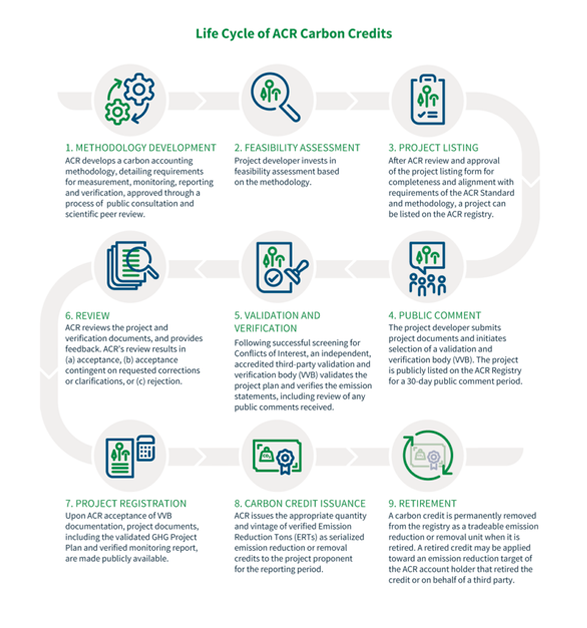
Developing a successful carbon project requires more than technological innovation. Projects must be structured in a way that satisfies regulators, investors and international credit buyers. Critical considerations include:
i. Regulatory Compliance-Ensuring projects meet the approval requirements under Kenya’s carbon market regulations.
ii. Carbon Ownership and Land RightsEstablishing clear legal rights to the carbon credits generated by a project.
iii. Carbon Credit Offtake AgreementsSecuring long-term purchase agreements with international buyers.
iv. Community Structures- Designing Benefit-Sharing transparent arrangements that comply with Kenya’s community participation rules.
v. Investment and Financing StructuresCreating project vehicles that attract institutional and climate finance investors.
The Strategic Role of Legal Advisors in Carbon Markets
As carbon markets become more sophisticated, legal structuring is emerging as a decisive factor in project success.

Carbon projects sit at the intersection of several complex areas of law, including:
i. environmental and climate regulation
ii. cross-border carbon trading rules
iii. project finance and investment structuring
iv. land rights and community benefit agreements
v. International carbon credit purchase contracts Companies entering the Kenya carbon credit market increasingly require advisors capable of navigating these overlapping legal frameworks.

Conclusion

As global demand for high-integrity carbon credits continues to grow, Kenya is emerging as a strategic destination for climate investment. Businesses seeking to enter this market must ensure that their projects are commercially viable, legally robust and aligned with international carbon market standards. With the right legal and strategic guidance, Kenya’s carbon market presents a compelling opportunity for investors and climate innovators alike. Reach out to us for a consultation through our contact details below.

By Teresia Wamaitha
Managing Partner