Screenshot from 2026-04-18 17-25-43

VIRAL AI CARICATURE TRENDS AND DATA PRIVACY CONCERNS: LESSONS FROM THE WORLDCOIN CASE

If you are an occasional user of social media platforms, you must have recently come across viral AI caricatures that portray people as cartoon characters and animated versions of their professions. With only a selfie and
a short prompt, AI tools can generate creative portraits depicting a person’s lifestyle, profession, and personality within seconds.

In Kenya, the issue has already drawn the attention of the Office of the Data
ProtectionCommissioner (ODPC). The Data Protection Commissioner, Immaculate Kassait, has cautioned Kenyans against casually sharing personal images with AI platforms without understanding how such data
may be stored, processed, or reused. These warnings are part of a broader data protection concerns in emerging technologies, which concerns were recently discussed by the High Court in the famous Worldcoin case; Republic v Tools for Humanity Corporation (US) & 8 others; Katiba Institute & 4 others (Exparte Applicants); Data Privacy & Governance Society of Kenya (Interested Party) (Judicial Review Application E119 of 2023) [2025] KEHC 5629 (KLR) (Judicial Review)

The Data Privacy Risks Behind the Trend The viral “AI caricature” trend poses several privacy concerns.
First, personal photographs and selfies constitute biometric identifiers. Your facial features can uniquely identify you, making them sensitive data under the Data Protection Act, 2019. As such, the AI companies, as data controllers, must obtain informed consent for such sensitive data.
Additionally, most of these AI companies operate across different jurisdictions that operate under different data protection laws, raising issues with-cross-border transfers.

The World Coin Case


Kenyan courts have already had the opportunity to develop sound jurisprudence on Data Protection in the face of emerging technologies in Republic v Tools for Humanity Corporation (US) & 8 others;
Katiba Institute & 4 others (Exparte Applicants); Data Privacy & Governance Society of Kenya (Interested Party) (Judicial Review Application E119 of 2023) [2025] KEHC 5629 (KLR) (Judicial Review).

While the facts of this case concerned different technologies and systems, the principles articulated by the High Court have broader implications for emerging technologies that rely on personal and biometric data including the now-popular AI caricature trends circulating on social media.

The Worldcoin case arose following the launch of the Worldcoin initiative, which sought to create a
global digital identity system through the collection of biometric data using a device known as the “Orb.” The device scanned individuals’ irises and facial features in exchange for cryptocurrency tokens.

Civil society organisations challenged the project before the High Court, arguing that the mass collection of biometric data violated Kenya’s constitutional and statutory data protection framework. In its decision, the High Court found that the entities involved had failed to comply with key requirements under the Data
Protection Act 2019. The High Court’s reasoning in the Worldcoin decision provides an important framework for evaluating such practices. The judgment set out several principles that are equally relevant in the context of the said AI caricature trend.

1. The processing of biometric data must occur within a clearly defined legal framework. Under the Data Protection Act 2019, entities that collect and process personal data must be properly registered as data controllers or processors and must demonstrate compliance with the obligations imposed by
the law.
2. Organisations that process sensitive personal data are expected to conduct Data Protection Impact Assessments where technologies pose potential risks to individuals’ privacy. AI platforms that analyse facial images could, in certain instances, fall within this category.
3. The issue of valid consent remains central. The Court in the Worldcoin case emphasised that consent must be free, informed, and specific. Where users upload personal data without a clear understanding of how it may be stored, analysed, or used to train AI systems, questions may arise as to whether such consent is actually informed consent.
4. Finally, the judgment also raised concerns regarding cross-border data transfers, especially where personal
data collected in Kenya may be stored or processed in foreign jurisdictions. Likewise, most of these AI companies are based outside of Kenya’s jurisdiction.

An interesting sidenote to this controversy is that the Worldcoin project was co-founded by Sam Altman, who also serves as the Chief Executive Officer of OpenAI, the organisation behind ChatGPT, the AI tool which most people use to generate such caricatures.

Conclusion
AI is here to stay, and as technology continues to evolve, both regulators and users must remain keen to ensure that technological advancements do not come at the expense of fundamental privacy rights. So far, the Office of the Data Protection Commissioner is doing a commendable job through its regular sensitization of the public regarding broad issues concerning data protection.

Screenshot from 2026-04-18 16-53-11

CITIZENSHIP BY NATURALIZATION LEGAL ALERT FEBRUARY 2026

A PRACTICAL LEGAL GUIDE FOR LONG TERM RESIDENTS SEEKING CITIZENSHIP
INTRODUCTION

Citizenship extends beyond legal status; it constitutes formal recognition of belonging, loyalty, and  participation within a nation. In Kenya, citizenship may be acquired by birth, registration, or naturalization. Citizenship by naturalization is particularly significant as it provides long-term foreign residents the
opportunity to become citizens of Kenya upon demonstrating contributions to national development.
However, while the law provides this opportunity, the process itself is detailed, discretionary, and often misunderstood. Applications may take time, require extensive documentation, and involve rigorous background checks.

The Legal Foundation of Citizenship by Naturalization Constitutional Basis Citizenship in Kenya is anchored in Chapter 3 of the Constitution of Kenya 2010. Article 15(2) of the Constitution provides that: A person who has been lawfully resident in Kenya for a continuous period of at least seven years, and who satisfies the
conditions prescribed by an Act of Parliament, may apply to be registered as a citizen.


Statutory Framework The primary legislation governing naturalization is the Kenya Citizenship and Immigration Act, No. 12 of 2011. Naturalization, therefore, is a formal application assessed by the state, guided
by statutory criteria and exercised at the discretion of the Cabinet Secretary. Under Section 13(1) of the Act, an
applicant must satisfy several cumulative conditions:

1. Lives in Kenya continuously for 7 years;
2. Be a resident with a valid permit or get an exemption from the Cabinet Secretary;
3. Has resided in Kenya for 12 months before making the application;
4. Has adequate knowledge of Kenya;
5. Speak Kiswahili or a local dialect;
6. Has not been criminally convicted; and
7. The Cabinet Secretary has to be satisfied that the applicant will reside in Kenya after the registration.
Requirements process


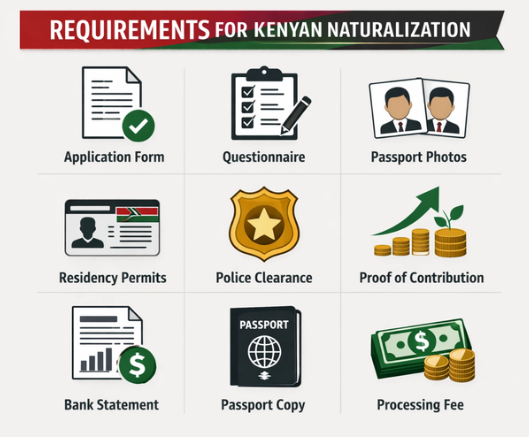
1. Duly completed application Form (10) attested to by a Commissioner for Oaths. This form is available on the eFNS portal.
2. Duly filled Questionnaire.
3. Passport size photographs.
4. Copies of Permits held for the last 7 years or the number of years the applicant has resided in Kenya.
5. Original certificate of good conduct/Police Clearance Certificate.
6. Letter of proof of contribution made in national development.
7. Personal Bank statement.
8. Passport Copy.
9. Application processing Fee – Kshs. 20,000/=.

Important Note: Section 13(2) of the Kenya Citizenship and Immigration Act provides that the Cabinet Secretary cannot register an applicant if the applicant’s country is at war with Kenya at the date of making the
application.
The Process of Naturalization
Step 1: Create an Account
This step involves creating an account
with the Kenyan electronic Foreign
Nationals Services (eFNS) portal which is
under the Department of Immigration
Services or an e-citizen account.
Step 2: Log-in
Log into the eFNS account and select the “Apply now” link
Step3: Application
Click on the “Submit Applications” tab and select the Lawful Residence tab. After the application is processed, an invoice will be generated which can be seen by clicking on “Dashboard” then “Payments” Tab. You shall receive automatic notifications via email and on your online account about the progress of your application.
Step 4: Background checks
Under this process, the department of immigration conducts criminal background, immigration history and
any security.
Step 5: Interview and Evaluation
Applicants are invited for interviews where they are tested on their knowledge about Kenya and the language.
Step 6: Decision by the Cabinet
Secretary The Cabinet Secretary exercises discretion to approve or reject the application.

Step 7: Oath of Allegiance
Upon approval, the applicant takes the oath of allegiance.
Step 8: Issuance of Certificate of Naturalization
A Certificate of Naturalization is issued, officially conferring Kenyan citizenship.

Conclusion
Citizenship by naturalization in Kenya is a carefully regulated process grounded in constitutional and statutory law. By requiring lawful residence, good character, cultural integration, and allegiance to the Republic, the law
ensures that naturalized citizens are genuinely committed to Kenya’s values and future. The process of naturalization is extremely thorough however, successful applicants are given full citizenship rights and responsibilities.

Our Team at ESK Advocates LLP is equipped with the knowledge and extensive network to assist foreign clients in the process of acquiring Kenyan citizenship through naturalization; from filling out the relevant forms,
procuring the requisite documents to interview preparation. Visit our office or call the number below for further assistance. Article by : Joyce Nduta Holding-Over Associate

Screenshot from 2026-04-18 16-53-11

VAT AND THE DIGITAL ECONOMY IN KENYA

WHAT THE SENDY LTD HIGH COURT CASE MEANS FOR DIGITAL PLATFORMS & BUSINESSES

INTRODUCTION

Technology has greatly evolved, and with such, digital platforms have transformed how business is done in Kenya and beyond. Many businesses now fully operate on digital platforms, whereby their business models involve providing services without owning physical assets, yet they play a critical role in connecting customers,
service providers, and payments. As these business models have grown, so too have questions around Value Added Tax (VAT). The drafters of the Value Added Tax Act (Cap 476) designed the provisions therein
with tangible goods and identifiable services in mind. However, applying the said provisions to digital platforms has proved to be more complex.

Recent decisions from the Tax Appeals Tribunal and the High Court have shown the complexity of applying provisions of the VAT Act on digital platforms. This article explores how VAT works in general, why digital platforms present unique challenges, and what recent decisions from the tribunal and the High Court mean for businesses operating in Kenya’s digital economy.

WHAT IS VAT AS PROVIDED BY LAW?

VAT in Kenya (as per the Value Added Tax Act Cap. 476) is a consumption tax imposed on the supply of goods and services. Although businesses are required to collect and remit VAT, the tax is ultimately borne by the end consumer.

When a VAT-registered business sells goods or services, it adds VAT to the selling price (this is called output VAT). The business can also claim back the VAT it has paid on its own business purchases and
expenses (this is called input VAT). The business then remits the difference between the VAT it collected and the VAT it paid. For VAT to apply, three basic conditions must be met:

1. There must be a supply of goods or services.
2. The supply must be made by a person or business registered (or required to be registered) for VAT.
The supply must be made in the course of doing business in Kenya.


This sounds simple, but more often than not, problems can arise in practice. Sometimes it is not clear whether a supply has actually been made, who is making the supply, or what exactly is being supplied.
This is especially common in business models, such as digital platforms, as explained below.

WHY DIGITAL PLATFORMS
TRADITIONAL VAT THINKING
CHALLENGE

The reason why applying the traditional rules of VAT on digital platforms is complex is that most of these digital platforms only act as intermediaries. They act as “middlemen” connecting consumers to service providers. They only provide the technology to facilitate the transactions, and in many instances, they are not the ones who provide the actual services. Take for example, the common digital platforms only to the platform’s commission or service fee? Who is responsible for accounting for VAT in the overall transaction?
These questions have raised disputes with the Taxman, who in most instances takes a broad interpretation in relation to payable VAT. Recent court decisions have now provided the much needed guidance on such disputes.

DECISIONS EMERGING FROM THE COURTS

In a recent High Court decision in Commissioner of Domestic Taxes v Sendy Limited (Income Tax Appeal E137 of 2024) [2025] KEHC 14814 (KLR), the court clarified instances where digital platforms may be deemed to be principal suppliers for VAT purposes, therefore liable for VAT on the full transaction paid by the customer rather than just the commission or service fee. like “Uber”, “Airbnb”, “Jumia”, just to name but a few.

Background This unique situation raises important questions. Is the platform supplying a service to the customer, or is it simply enabling a transaction between third parties? Should VAT apply to the full value
of the transaction, or Sendy Limited (Respondent) operated a digital marketplace for delivery services
connecting third-party customers with independent transporters.

According to the Respondent, the transport services were provided by the third-party suppliers, and the Respondent’s income was limited to its commissions charged to the transporters for the use of its platform.


In its case before the Tax Appeals Tribunal, the Respondent showed its audited financial statements,
sample commission agreements with transporters, and witness testimony to support its assertion that it had
accounted for the VAT on its commissions. Additionally, the Respondent had earlier received a private ruling from the Appellant that the Respondent was liable for VAT only on its commissions. The Tribunal ruled in the
Respondent’s favor, finding that it did not provide transport services.

The Commissioner of Domestic Taxes (Appellant), on the other hand, stated that the Respondent was the principal supplier of the transport services. According to the Appellant, the Respondent exercised significant control over the services provided on its platform. The Respondent controlled the customer relationship
through its digital application, dispatched the nearest available driver, determined the price, issued the demand for payment, and, most importantly, received full payment for the services.

The Appellant therefore argued that the Respondent was liable for VAT on all fees collected from the customers, not just from commission. Determination The main issue for determination was whether the Tribunal erred in concluding that the Respondent was not supplying transport services. In addressing this issue, the court examined section 5 of the VAT Act and noted that the Act provides for a broad definition for supply of goods, but it does not establish specific criteria for identifying the supplier in intricate, multi-party arrangements conducted through digital platforms.

In the absence of specific provision under our domestic laws, the court turned to jurisprudence arising from the Court of Justice of the European Union (CJEU) under the harmonized EU VAT framework. A foundational principle in EU VAT Law is that the characterization of a transaction must be based on its objective characteristics, reflecting its economic and commercial reality.

It considered Article 28 of the EU VAT Directive, which stipulates that an intermediary acting in its own name but on behalf of another is treated as having both received and supplied the underlying service. The court reviewed several CJEU authorities, including a decision establishing that a digital platform is presumed to act in its own name and thus to be the deemed supplier, where it participates in the supply. The CJEU further held that this presumption becomes conclusive where the platform either;

(i) authorizes the charge to the customer or the delivery of the service, or
(ii) determines the general terms and conditions of the supply. In short, the degree of control a platform
exercises over the underlying supply is the critical determinant. As such, the High Court overturned the
decision of the Tribunal and allowed the Appeal. It found that Sendy Ltd exercised substantial control
over the core components of the transaction by fixing prices, allocating drivers, and overseeing the invoicing and payment process. On that basis, the Court concluded that Sendy functioned as the principal supplier for VAT purposes.


With respect to the prior private ruling from the KRA, the court acknowledged that Section
65 of the Tax Procedures Act renders such rulings binding to the commissioner. However, it held that this binding effect does not diminish the judiciary’s constitutional mandate to interpret laws.

IMPLICATIONS OF THE JURISPRUDENCE FROM THE COURT
The emerging jurisprudence implies that VAT compliance for digital business requires meticulous planning. Their liability for VAT compliance is determined by their substantive role in the transactions rather than what they have labelled themselves. Therefore, businesses in the digital platform should regularly review their positions to ensure they are always compliant.

The decision also means that taxpayers might have to reconsider prior private rulings from the KRA, because while Section 65 of the Tax Procedures Act renders such rulings binding to the commissioner, the court stated that it cannot diminish the role of the Courts in interpreting the law.

HOW ESK ADVOCATES LLP CAN ASSIST
The Sendy Limited decision confirms that VAT liability in Kenya’s digital economy depends on economic
substance and operational control — not labels. Our Tax Law Practice helps digital platforms, fintech
companies, SMEs, and corporates assess and manage VAT risk with clarity and precision.

We assist with : VAT risk assessments for digital platforms Structuring marketplace and commission models
KRA objections, tax disputes, and appeals Private ruling applications and regulatory advisory
Proactive VAT compliance reviews If your business controls pricing, customer relationships, or payment flows, your VAT exposure may extend beyond commissions.


Screenshot from 2026-04-18 16-34-41

THE COLLAPSE OF UNITED INSURANCE: REGULATORY FAILURE, JUDICIAL REMEDY, AND THE IMPERATIVE OF LEGAL REPRESENTATION FOR POLICYHOLDERS

INTRODUCTION
Imagine paying your insurance premiums faithfully for years, only to find that when you need coverage
most, following an accident or liability claim, your insurer is insolvent. Worse, imagine being personally
exposed to court decrees and execution of your assets because the insurance company you trusted can
no longer meet its obligations.
This was the reality for hundreds of policyholders of United Insurance Company Limited. However, a
recent landmark judgment by the Court of Appeal at Nairobi in Civil Appeal No. 61 of 2014, Commissioner
of Insurance -vs- Kensilver Express Limited & 192 Others has set a powerful precedent for insurance
consumers in Kenya.


The Case That Changed the Landscape United Insurance Company Limited, a Kenyan motor vehicle insurer, faced liquidity crisis from 1999 onwards. The Insurance Company was in the business of issuing third party insurance policies in particular, to public service vehicles.

The Commissioner of Insurance was aware of the company’s deteriorating financial position from 1999 and he found that the major problem facing the company was failure to separate ownership of the company from its management. Over the years, the Commissioner took various administrative steps such as: facilitating management restructuring, directing asset sales, and attempting to negotiate with the insurer’s principals.
These efforts did not yield any fruits which eventually led to the company being placed under Statutory Management.

The Commissioner of Insurance with the approval of the Minister of Finance appointed Kenya Reinsurance Corporation (Kenya Re) as the Statutory Manager under Section 67C of the Insurance Act (Cap 487). On 18th July, 2005, Kenya Re declared a moratorium through the daily newspaper for a period of one year. This meant that the Insurance Company could not give legal representation to their clients and if Judgment was entered against them, they could not settle the decretal sum.

As a practical consequence, 193 Judgment Creditors, mostly motor vehicle accident victims or their  dependents had their court decrees frozen. The Judgment Debtors were forced to settle the decretal sums and those who were unable to do so, faced civil imprisonment. The policyholders approached the court, arguing that their constitutional rights to liberty and peaceful ownership of property were violated by the regulatory failure to

Findings from the
Court of Appeal Judgment

1. Regulatory Diligence is Mandatory 

The Court affirmed that the Commissioner of Insurance and the Minister of Finance have a statutory
duty to act with expediency and diligence in the public interest, and cannot sit on known financial
troubles of an insurer until it is too late. While the Court of Appeal noted the Commissioner had held
meetings to try and salvage United Insurance when it began showing signs of trouble in 1999, it
affirmed that delaying intervention while knowing an insurer is failing constitutes a breach of duty to
the public, as regulators must act before a collapse becomes inevitable.

Why It Matters to You:

•Preventive Protection: Regulators cannot wait until an insurer is completely insolvent
before stepping in. If the Commissioner of Insurance delays intervention while knowing
an insurer is distressed, policyholders left exposed during that delay may have grounds
for recourse.

•Continuity of Cover: The law expects regulators to prioritize the continuity of insurance
cover for the public. If regulatory delay leaves you uninsured against third-party claims,
the state may bear responsibility for the gap.

2. Government Liability for the Compensation Fund Perhaps the most significant holding for consumers was regarding the Policyholders Compensation Fund (PCF). The Court held that the Government was responsible for losses suffered due to the failure to operationalize the PCF because it exists specifically to cushion policyholders when insurers become insolvent or when they are under Statutory Management. Although the
Fund existed in law since 1985, it was not operational until 2005. The Court ruled that this delay violated policyholders’ rights.

Why It Matters to You:

•State Liability: While the Policyholders Compensation Fund is now active, this judgment establishes that the Fund exists to protect you, not to create hurdles. The Insurance Act provides that the Policy-holders Compensation Fund shall provide compensation to the claimants of insurer placed under a manager or whose license has been cancelled under the Act

•Safety Net Enforcement: The Court affirmed that the Fund’s purpose is to compensate policyholders of insolvent insurers. This strengthens your legal position when filing claims against the PCF for Xplico or Invesco policies. It is a statutory right.


3. Constitutional Rights

Trump Administrative Moratoriums The judgment reinforces that administrative measures like moratoriums and statutory management cannot indefinitely violate fundamental constitutional rights to liberty and peaceful ownership of property. The case arose because policyholders were facing execution of decrees, seizure of assets, and even civil imprisonment because their insurer could not pay third-party claims during the moratorium.
The Court recognized that while regulators may implement temporary protective measures to address
insolvency, these measures cannot leave policyholders indefinitely vulnerable to enforcement actions or strip them of constitutional protections. The balance between administrative convenience and individual rights must ultimately favor the policyholder when the state has failed to prevent the collapse or provide timely alternative remedies.

Why It Matters to You:

•Protection from Personal Liability: If you held a valid third-party policy, you should not be personally liable for debts the insurance was meant to cover. If an insurer’s insolvency exposes you to personal execution, the law provides avenues to stay those proceedings.

• Human Rights Compliance:
The judgment affirms that policyholders cannot be subjected to civil jail merely because their insurer failed to meet its obligations. The High Courtreferenced United Nations Conventions prohibiting imprisonment for debt. A principle that remains persuasive authority for protecting insured persons from personal liberty violations arising from insurer insolvency


PRACTICAL LESSONS
EVERY POLICYHOLDER
SHOULD KNOW

From the Landmark Kensilver Judgment & the current Insurance Landscape
1. Verify Before You Buy4. Documentation Is Your Shield United Insurance had liquidity problems as early as
1999—but policyholders kept paying premiums unaware.
Always confirm your insurer’s licensing status and financial health via the Insurance Regulatory
Authority (IRA) portal before purchasing or renewing cover.The petitioners had to prove they were genuine
policyholders with valid contracts. The Court emphasized strict verification to eliminate fraud,
but also protected bona fide claimants.

2. Conflict of Interest in Statutory Management Is Unlawful
The Court held that Kenya Reinsurance Corporation ought not to have been appointed Statutory
Manager of United Insurance because, as a reinsurer, it was potentially a debtor to the insolvent
insurer therefore creating a real or potential conflict of interest.
The entity managing your insurer (e.g., PCF managing Xplico) must act solely in your interest and not to protect its own financial exposure. Any bias or conflict that delays or reduces your settlement is legally challengeable.

3. Your Cover Survives
Insurer Insolvency, if You Act The Court affirmed that policyholders retain enforceable rights under their insurance contracts even when the insurer is under statutory management. The moratorium suspends claims settlement however, it does not eliminate your cover. If your insurer is placed under Statutory Manage
ment or is insolvent, one can still get compensation through the Policyholders Compensation Fund
under Section 179 (1) of the Insurance Act (Cap 487) Your policy documents, premium receipts, claim
forms, and correspondence are critical evidence. Without them, even valid claims may be rejected.

5. Your Constitutional Rights Shield You from Personal Execution Policyholders cannot be indefinitely exposed to asset seizure or civil jail merely because their insurer failed to pay decretal sums in Judgments.
If you face personal liability due to an insurance company being placed under Statutory Manage-
ment or is insolvent therefore unable to pay decretal sums owed, seek urgent legal intervention to
stay execution proceedings.

How ESK Advocates LLP Can Help

Navigating insurance insolvency, statutory management, and claims against the Policyholders
Compensation Fund requires specialized legal expertise. The legal framework is complex, and
insurance companies often rely on technicalities to deny claims.

Don’t let insurance failure compromise your future. The law is on your side, but you need the right
advocates to enforce it. The Commissioner of Insurance v Kensilver Express Limited judgment
proves that with diligent legal representation, your rights can be protected. If you are facing challenges with an insurance claim, an insolvent insurer, or regulatory disputes, contact us today for a consultation.